
BUSINESS
Palo Alto Networks Stock Slips as the $20 Billion Bet Tightens
Palo Alto Networks beat Q4 and raised sales, yet the stock faded as fiscal 2027 NGS ARR growth slows to 22% and free cash flow stays at 38%.

Palo Alto Networks shares closed at $362.09 on Tuesday, down 5.24%, then slipped further after hours despite a fourth-quarter beat. Next-Generation Security annual recurring revenue reached $9.10 billion, up 63%.
Chairman and chief executive Nikesh Arora again tied that print to a $20 billion NGS ARR target for fiscal 2030. The tape treated the quarter as a test of whether those contracts still turn into cash after a year of giant deals.
Palo Alto Networks Beat the Quarter and Still Sold Off
The figures landed after the closing bell on September 1 for the quarter ended July 31. Regular trading had already knocked the stock 5.24% from Monday’s $382.13 close, on a tape that was weaker across the market. After hours the shares popped, then faded to about $355.21, down 1.9% from the cash close and about 7% below Monday.
That path matches a year in which the stock had already gained 96.57% through Tuesday’s close and had traded as high as $398.88 on August 13. At Tuesday’s close the company was valued at about $295.1 billion. A beat was priced in. A clean raise on cash was priced in too.
THE Q4 PRINT
- Revenue: $3.41 billion, up 34%, above the company’s $3.345 billion to $3.355 billion guide and above the $3.35 billion FactSet consensus.
- Adjusted EPS: $1.02, against $0.98 on the Street and a $0.96 to $0.98 company range.
- NGS ARR: $9.10 billion, up 63%, with about $970 million of net new ARR in the quarter, up 98%.
- Backlog: Remaining performance obligations of $21.2 billion, up 34%, the first print above $20 billion.
The company’s own fiscal fourth quarter and full-year results also showed the GAAP cost of the shopping year. Operating income fell to $172 million from $497 million a year earlier. The quarter produced a GAAP net loss of $282 million, or $0.35 a share, against net income of $254 million, or $0.36 a share, in the year-ago period. Adjusted operating income rose to $1.0 billion from $768 million.
Full-year revenue was $11.48 billion, up 24% from $9.22 billion. Adjusted earnings were $3.84 a share, up 15%. Cash, cash equivalents and investments ended the year at $7.9 billion.
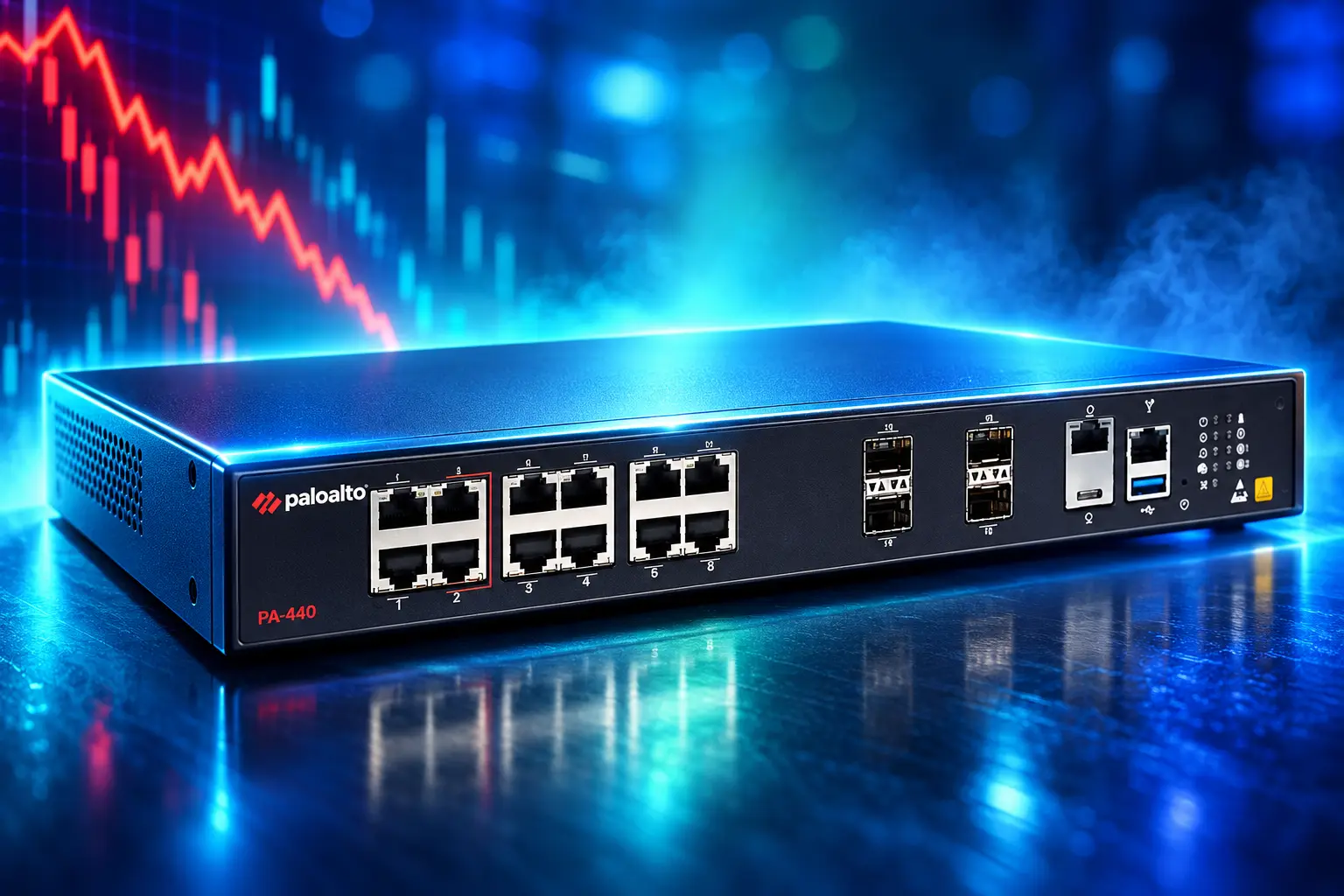
The $20 Billion ARR Target Now Needs 22% Compound Growth
Arora raised the Next-Generation Security ARR goal from $15 billion to $20 billion early in fiscal 2026, after agreeing to buy CyberArk and Chronosphere. The fourth quarter is the first clean look at how much of that climb still has to come from the combined company rather than from closing those deals.
The company’s earnings slides on NGS ARR growth put net new NGS ARR at about $970 million in the quarter. In June, management had separated the organic book: NGS ARR excluding $1.63 billion from CyberArk and Chronosphere was $6.5 billion, up 28%. The 63% headline rate in July is still lapping a base that did not yet include those businesses.
THE NGS ARR PATH TO $20 BILLION
| Milestone | NGS ARR | Year-on-year growth |
|---|---|---|
| Q4 fiscal 2025 | $5.58 billion | 32% |
| Q4 fiscal 2026 | $9.10 billion | 63% |
| Fiscal 2027 guide | $11.075 billion to $11.175 billion | 22% to 23% |
| Fiscal 2030 target | $20 billion | about 22% compound from here |
From $9.10 billion at year-end to $20 billion in four years is a 21.8% compound rate. From the fiscal 2027 midpoint of about $11.125 billion, the same $20 billion in three years is 21.6%. The new full-year guide of 22% to 23% is not a re-acceleration plan. It is the rate the $20 billion target already requires, held for three more years, after the acquisition bump rolls off.
First-quarter ARR is still guided up 63%, to $9.54 billion to $9.56 billion, because that comparison is against $5.85 billion in the year-ago quarter, before CyberArk was in the numbers. The 22% to 23% full-year rate is the first look at growth once those deals sit in the base.
Free Cash Flow Margin Holds at 38 Percent
Adjusted free cash flow was $1.29 billion in the quarter, against $954 million a year earlier. For the full year it was $4.41 billion, up 26%, a 38.4% margin, 40 basis points above fiscal 2025’s 38.0%. Chief financial officer Dipak Golechha told investors the company still aims for a 40% adjusted free cash flow margin in fiscal 2028.
Guidance for fiscal 2027 puts that margin at 38.0%. That is a 40 basis-point step down from the year just finished, and it leaves a 200 basis-point jump for fiscal 2028 if the 40% target is going to be hit on time. Andrew DeGasperi, an analyst at BNP Paribas, said the 37.5% to 38% cash-flow outlook looked light against what buyers of the stock had modeled, and he tied the after-hours swings to that gap.
WHERE EXPERTS DISAGREE
- DeGasperi: The new free-cash-flow margin range came in light versus buy-side models, which is why the shares were volatile after the print.
- Fortt: Journalist Jon Fortt wrote on X that the 38.4% full-year cash margin was better than feared given the CyberArk integration.
- Golechha: Annual billings have risen from 6% of bookings in fiscal 2020 to about 30% in fiscal 2026, which he said makes the cash engine more predictable from here.
Both readings can sit in the same quarter. The company did throw off more cash, $4.41 billion of it. It did not guide that margin up. After a 96.57% year-to-date run, the multiple is paid on the next 200 basis points, not on the last 40.
CyberArk, Chronosphere and a Same-Day Console Deal
Fiscal 2026 was the year Palo Alto Networks stopped looking like a firewall vendor that dabbled in software. It closed the two largest purchases in its history, then bought another AI company on the same afternoon it reported the year.
THE 2026 BUYING LIST
- Chronosphere: Cloud observability, a $3.35 billion deal closed in January and now sitting inside Cortex.
- CyberArk: Identity security, a $25 billion deal closed in February and now reported as the Idira platform.
- Koi and Portkey: Smaller closes in April and May, aimed at agentic endpoints and AI-agent security.
- Console: An AI-native workflow company bought on September 1, terms undisclosed, to sit in Cortex.
The acquisition of Console for agentic workflows is the tell on how management wants the next leg of the $20 billion target to be built. Arora is not asking customers to click through more dashboards. He is asking them to talk to the platform.
Security operations can no longer be about managing dashboards and queuing tickets just to help humans work faster. By bringing Console into Palo Alto Networks, our customers can have a direct conversation with data and build agentic workflows in natural language that helps alert and remediate issues automatically. This is the shift to software-as-an-agent, giving our platform the arms and legs to deliver autonomous security outcomes across the entire enterprise.
Nikesh Arora, chairman and CEO, Console acquisition statement
Andrei Serban, Console’s co-founder and chief executive, said customers already use agents to cut overhead, and that Palo Alto Networks gives the team the scale to take that model into the largest enterprises. Terms were not disclosed, so the cash cost of this deal is not in the 38.0% margin guide in a way investors can see. It is another integration on top of CyberArk and Chronosphere, which Golechha has said are running three to six months ahead of the original profit-convergence plan.
What Fiscal 2027 Guidance Implies
Management did raise the top line. Fiscal 2027 revenue is guided to $14.10 billion to $14.20 billion, up 23% to 24%, above the $13.84 billion Wall Street had on the sheet. Adjusted earnings are guided to $4.16 to $4.19 a share, against $4.11. Non-GAAP operating margin is guided to 29.5%, a small step up from the 29.2% full-year mark just printed, and from 29.6% in the fourth quarter.
Q1 AND FULL-YEAR 2027 GUIDE
| Metric | Q4 actual | Q1 fiscal 2027 | Fiscal 2027 |
|---|---|---|---|
| Revenue | $3.41 billion | $3.300 billion to $3.310 billion | $14.10 billion to $14.20 billion |
| NGS ARR | $9.10 billion | $9.54 billion to $9.56 billion | $11.075 billion to $11.175 billion |
| RPO | $21.2 billion | $20.8 billion to $20.9 billion | $25.2 billion to $25.4 billion |
| Adjusted EPS | $1.02 | $0.96 to $0.98 | $4.16 to $4.19 |
| Adjusted FCF margin | 38.4% (full year) | not guided | 38.0% |
The sequential dip in remaining performance obligations, from $21.2 billion down to a $20.8 billion to $20.9 billion first-quarter range, is the seasonal pattern after a July year-end, and the full-year RPO climb to $25.2 billion to $25.4 billion still implies 19% to 20% growth. Current RPO ended the year at $9.3 billion, up 34%. Product revenue in the fourth quarter was $738 million. Diluted share count for the first quarter is guided to 837 million to 844 million, then 844 million to 847 million for the year.
First-quarter revenue of $3.300 billion to $3.310 billion still sits above the $3.22 billion consensus, and first-quarter adjusted EPS of $0.96 to $0.98 sits above $0.93. The raise is real. It is a raise that keeps cash-flow margin still and lets ARR growth settle at the rate the 2030 target already needs.
Record Platform Deals Are Getting Larger
On the Q4 fiscal 2026 earnings call webcast, Arora walked through why he thinks that 22% rate is holdable. The company booked about 220 net new platformizations in the quarter, up 44%, more than twice the pace from two years ago. More than 65% of NGS ARR now comes from customers on those platforms, and net revenue retention in that group exceeded 120%.
Accounts with more than $5 million of NGS ARR rose 45% to 223. Accounts above $10 million rose 50% to 78. Those counts exclude CyberArk and Chronosphere, because the company has no matching year-ago base for the acquired books. The long-term target is more than 4,000 platformizations by fiscal 2030, which Arora called the bedrock of the $20 billion ARR goal. The company puts the market it can reach at about $340 billion by 2030.
Three named deals sat under that pitch. A global telecoms group signed a $126 million agreement to standardize network security, including Prisma Access for SASE. A large IT services firm signed for $72 million across Network and AI Security, Cortex and Idira, with eight-figure spend in each. A global payments platform signed for $53 million, including a high-seven-figure commitment to Prisma AIRS, the AI-runtime product that crossed $100 million of ARR in four quarters, the fastest ramp in the company’s history. XSIAM, the security-operations cloud, is above $700 million of ARR and grew 70%.
Arora used the call to argue that three AI shifts in six months, OpenClaw’s agentic jump, the Mythos models that find and exploit bugs at machine speed, and the spread of open-weight models inside companies, all push traffic, data and machine identities onto the same platforms. Prisma AIRS and XSIAM are the products he wants that argument to land on. Console is the tool he just bought to make the operations layer answer in plain language.
The latest advancements in AI are elevating cybersecurity to the top of the CIO priority list, and will serve as durable tailwinds as we progress towards our $20 billion FY30 NGS ARR target.
Nikesh Arora, chairman and CEO, fiscal 2026 results statement
A $295 Billion Multiple Is Waiting on Fiscal 2028
Golechha’s line on the same release was narrower. He said the profitable-growth plan is scaling, and that it backs the 40% adjusted free cash flow margin in fiscal 2028. He also said CyberArk’s profit conversion is running three to six months ahead of plan. The fiscal 2027 sheet still prints 38.0%.
Holders who rode the stock from the February low near $139.57 to Tuesday’s $362.09 close are not arguing about whether CIOs are spending on AI security. The $9.10 billion ARR print and the $21.2 billion backlog settled that. They are arguing about the next 200 basis points of cash margin, and about whether 22% ARR growth is a floor or the start of a slower company.
Fiscal 2028 is the year the 40% cash margin is supposed to appear. Until that print, the $20 billion ARR target is a growth plan that still has to throw off the cash a $295.1 billion valuation is already counting.
Disclaimer: This article is news reporting and analysis of Palo Alto Networks’ fiscal 2026 results and share-price move, and it is for information only. It is not investment advice, a recommendation to buy or sell PANW or any other security, or a forecast of future returns. Readers should consult a licensed financial adviser or other qualified investment professional before making any decision based on earnings figures, guidance or valuation. Revenue, margin, ARR and share-price numbers reflect company filings, official statements and market data as of September 2, 2026, and those figures can change with later filings, guidance updates and trading.

Trump Claims Eight Wars as Oslo Weighs the Peace Prize

Valkyries and Dream Leave Two Contenders at 0-2

Caroline Pham Teased Ripple as MoonPay Sold ether.fi

The $399 Kickr Core 2 Deal Is a Winter Hook

India Plans to Bar Cane Juice From Ethanol Production

A Quiet German Wiki Caught OpenAI’s Agent Swarm

LSU Players Carry the Cost of Kiffin’s NFL Additions

Welspun’s Record US Order Is Still a Gas Export Line

Palo Alto Networks Stock Slips as the $20 Billion Bet Tightens

Carnegie Deli Reopens in the Stage Deli’s Old Shop
-
 NEWS2 months ago
A Quiet German Wiki Caught OpenAI’s Agent Swarm
-
 NEWS2 months ago
LSU Players Carry the Cost of Kiffin’s NFL Additions
-
 BUSINESS2 months ago
Welspun’s Record US Order Is Still a Gas Export Line
-
 LIFESTYLE1 month ago
Carnegie Deli Reopens in the Stage Deli’s Old Shop
-

 BUSINESS1 month ago
Treasury’s $6 Billion Buyback Leaves the 10-Year Higher
-
 NEWS1 month ago
The Narcolepsy Pill That Opens a Wider Brain Bet
-

 NEWS1 month ago
vivo X500 Pro Max Keeps Last Spring’s Camera Island
-

 BUSINESS1 month ago
Trump Times the Iran War to the Midterm Calendar