
BUSINESS
Welspun’s Record US Order Is Still a Gas Export Line
Welspun Corp’s $1.8 billion US order is a Permian export pipeline, and both Indian pipe stocks already trade above their own history after 2026’s rally.

Welspun Corp won a $1.8 billion (₹17,200 crore) US pipe order on 20 August, taking its global book to ₹42,100 crore. The work runs in FY28 and FY29 from the American mill, and managing director Vipul Mathur later called the job a Permian Basin export pipeline.
Welspun Corp and DEE Development Engineers have been packed into the AI data-center trade after 214% and 182% gains in 2026. Together they now carry ₹44,528 crore of orders. The contract that doubled Welspun’s book will move Permian gas toward export, and management still puts about 75% of the US mix in LNG lines.
The $1.8 Billion Order Is a Permian Export Line
On 20 August the company told the exchanges it had secured the largest single order in its history, valued at about $1.8 billion, for pipe from its United States plant. Company secretary Kamal Rathi signed the filing that night. The customer, the tonnage and the pipe type were not named. Execution sits in FY28 and FY29, so almost none of it lands in the current year.
That single ticket is about 41% of the ₹42,100 crore book. Mathur said the firm will not spend an extra rupee of capex to build it. The $200 million to $250 million already going into Little Rock, plus some debottlenecking, is meant to cover the work. Prices are fixed, and US steel is tied to local suppliers, so the mill is not sitting on a floating metal bet for four years.
We have some scope for capacity augmentation within our existing facilities, which we are going to undertake. We also have some debottlenecking to do.
Vipul Mathur, Managing Director and CEO, Welspun Corp
The tape had been climbing for weeks before the filing, and the first public read was that the size of the order was already in the price. Shares jumped as much as 17% on 21 August and closed at ₹2,306.40 on the BSE that day. By Tuesday they had closed at ₹2,553.60, a 214% rise in 2026, with a market value of about ₹67,335 crore.
HOW THE ORDER BOOK JUMPED IN 2026
- 24 July 2026: Q1 results put the global book near ₹24,750 crore, with US mills described as booked through FY28.
- 27 July 2026: A ₹960 crore coated line-pipe job from Little Rock lifts the order book to Rs. 25,750 Crore, then a record $2.7 billion.
- 20 August 2026: The $1.8 billion US contract takes the book to $4.4 billion, or ₹42,100 crore, the highest in the company’s history.
- 1 September 2026: Welspun and Perma-Pipe announce a memorandum to study pipe-making and coating facilities in Jordan.
Mathur has also sketched an earnings path that sits well beyond this year’s guide. He put FY27 EBITDA at the ₹2,800 crore area, against the official ₹2,850 crore target, and said about ₹5,000 crore by 2029-30 would be a fair estimate if the US mill runs the new book. That is a statement about utilisation, not about a new product.
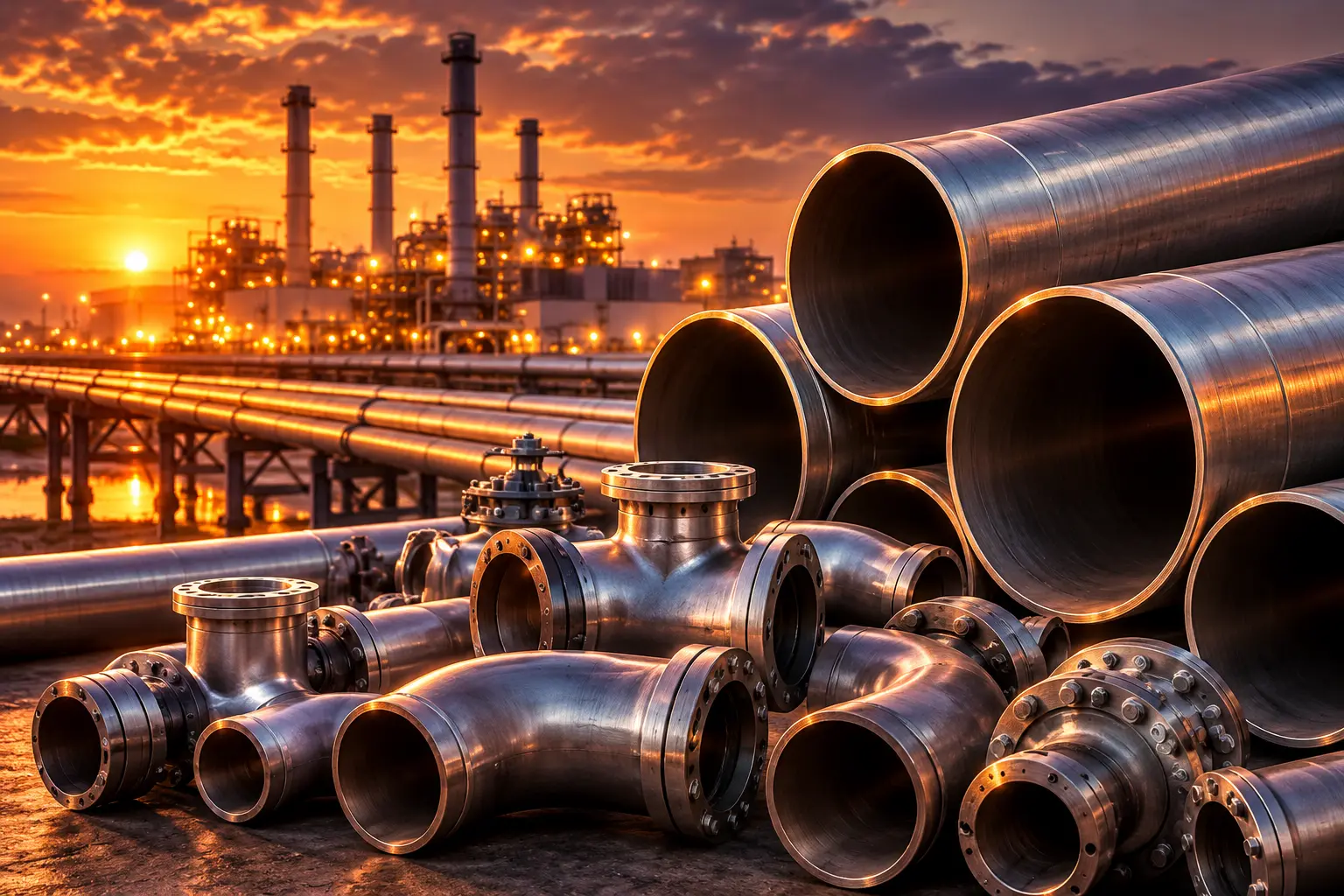
Three-Quarters of the US Book Still Points at LNG
Welspun is the largest global maker of large-diameter line pipe and claims 33 to 35 percent US market share in that product. The US mill currently turns out 300,000 to 350,000 tonnes a year. Two expansions in Little Rock add 200,000 to 250,000 tonnes, a 60% to 70% lift, with the HFIW mill already commissioned and the LSAW mill due by the end of FY27. Full volume from those assets is a FY28 story.
On the Q1 call Mathur said that, in the current view, the US portfolio is something like 75% and 25%. The larger slice is LNG export lines. The smaller slice is gas laterals that feed power plants next to data centers. He also said he would “love to do data centers as much as possible,” and that he does not pick the mix; LNG and data-center jobs arrive in the same window and the mill takes the better margin.
THREE DEMAND PILLARS IN THE US MILL
- LNG export lines: Cheap Henry Hub gas against a much higher international price has kept Gulf Coast evacuation pipes in the queue, and this remains the bulk of what the mill is welding.
- Oil gathering and export: After years of underbuild, crude lines out of the shale patch have come back, and the 20 August award is a Permian export job sitting in that stream.
- Data-center gas laterals: Developers putting gas turbines beside rural halls need steel to move fuel over distance, and management wants this slice to grow from about a quarter of the US book.
The United States was 27.2% of Welspun’s FY26 revenue. India was 71.7%. Even a fully booked American mill is still a minority of group sales, and the domestic water pipe market is slow. Mathur said Jal Jeevan funding is tight, ductile-iron capacity in India is surplus, and the company has shifted that effort toward exports and pig iron. Grid operators at home still talk about adding about 10,000 km to the national gas grid, which would help indirectly. It is a pipe cycle with an AI overlay, not an AI company that happens to roll steel.
How Much of the 189 GW Gas Queue Will Need Pipe?
Global Energy Monitor counted more than 189 GW of US gas-fired capacity aimed at data centers by mid-2026, up from 97 GW at the end of 2025 and 4 GW in early 2024. That is the figure bulls use when they call line pipe an AI tool. It is a development queue, not a fleet that is running.
US GAS PLANTS TIED TO DATA CENTERS
- Early 2024: GEM tracked about 4 GW of gas projects aimed at data centers.
- End 2025: The same tally had reached 97 GW, already more than a third of the US gas queue at the time.
- Mid-2026: The data-center slice hit 189 GW, while the total US gas pipeline rose to 378 GW, with 52 GW actually under construction.
Jenny Martos, who works on GEM’s plant tracker, said the US gas buildout is now tied directly to the data-center buildout. She also said it is nearly impossible to guess which proposal is real. Pre-construction and announced jobs are about 86% of the US queue. Cleanview founder Michael Thomas has put the historical completion rate for proposed US gas plants near 30%. Apply that rate to 378 GW and the installed addition looks closer to 11 GW a year over a decade, not a doubling of the fleet.
WHAT WE KNOW
- Construction: US gas plants under construction rose 76% in the first half of 2026 to 52 GW, of which about 16.9 GW is meant for data centers.
- Dedicated plants: The Environmental Integrity Project has listed 74 gas plants planned for data centers, a named-project count of 143 GW, narrower than GEM’s 189 GW development net.
- Grid math: JLL has put global data-centre IT capacity at 103 GW in 2025, rising toward 200 GW by 2030, with up to $3 trillion of related investment.
WHAT IS UNCONFIRMED
- Miles of pipe: No public split shows how many of those plants need a new long-haul line rather than a short lateral off an existing header.
- Welspun’s share: A 33% to 35% grip on large-diameter US line pipe does not tell you how much of the 189 GW queue is large-diameter work, or how much goes to rivals.
The US Energy Information Administration already treats data centers driving US electricity demand as the main reason load is rising, with a 1.9% increase in 2026 and gas still about 40% of generation in 2025. Large turbines are largely sold out through 2030, which is why developers pair halls with on-site gas. That pairing is real. Converting a press release in Texas into tonnes at Little Rock is the part the 214% rally has treated as a given.
DEE’s Thailand Plant Is Sold Out on Steam, Not Servers
DEE Development Engineers is India’s largest process-piping company by installed capacity, with 93,500 tonnes of piping and 32,400 tonnes of heavy fabrication across seven plants in India and Thailand. Chairman and managing director K.L. Bansal has a ₹2,428 crore book as of 30 June, about two years of sales, after 92.5% growth in the book over the year. Exports are more than half of it.
The AI slide in the pitch is cooling pipe inside halls and high-pressure pipe on heat-recovery steam generators that sit behind gas turbines. Management has talked about ₹25 crore of piping per 25 MW of data-centre capacity, and says the data-centre job list is strong for the near to medium term. Those jobs are not the book you can count today.
The Thailand plant, 14,500 tonnes a year, is the piece that is actually sold out. About 60% of its HRSG spool capacity is reserved under an agreement with a US engineering firm, with a minimum annual job value of $15.27 million and visibility to 2029. Bansal has put Thailand revenue in a ₹170 crore to ₹200 crore band and said there is no plan to expand that mill. The offtake is specialised steam pipe for names such as Siemens, GE and Nooter Eriksen. GE HRSG work has faced delays. A Siemens memorandum covers piping for 10 gas-turbine units next year at €1 million to €1.5 million each, a useful reference, not a second Welspun-sized ticket.
The order that actually moved the domestic book is older economy. Bharat Petroleum placed a ₹386.82 crore piping contract, due by February 2028. Bansal has said the core power, oil and gas, chemicals and process book remains the main driver, with more than ₹2,000 crore of inflows targeted this year and the book near ₹3,000 crore by March. The Anjar mill is being taken from about 60% to 65% use this year toward full use by FY29. FY27 guidance is ₹1,500 crore-plus of revenue and an EBITDA margin above 19%, with a longer aim of ₹2,500 crore and 20% margins by FY30.
Q1 Results Show a Pipe Cycle Already in Motion
Both companies printed strong April-June numbers. They are the numbers of mills that already had work, not of a thesis that still needs a first order.
Q1 FY27 OPERATING SNAPSHOT
| Particulars | Welspun Corp | DEE Development |
|---|---|---|
| Revenue | ₹4,081 crore (+15%) | ₹294.5 crore (+31.6%) |
| EBITDA | ₹756 crore (+35%) | ₹49.7 crore (+38.7%) |
| EBITDA margin | 18.5% | 16.9% |
| Adjusted net profit | ₹499 crore (+42%) | ₹16.1 crore (+22.4%) |
| Order book | ₹42,100 crore (20 Aug) | ₹2,428 crore (30 June) |
| FY27 guide | ₹20,000 crore sales, ₹2,850 crore EBITDA | ₹1,500 crore-plus sales, margin above 19% |
Welspun’s reported profit of about ₹1,046 crore in the quarter includes a ₹548 crore exceptional gain from a partial sale of its Saudi associate East Pipes Integrated Company. Strip that out and the operating profit rise is the 42% print on ₹499 crore. Net cash was ₹2,336 crore after ₹834 crore of capex in the quarter, and ROCE came in at 23.1%. Saudi work is meant to contribute in the second half. India, as Mathur told the call, is the geography he has de-emphasised.
DEE is growing faster off a much smaller base. Core piping rose 33% in the quarter. Margin is still below the 19% full-year aim because Anjar is not yet full. The company also completed a ₹300 crore preferential issue to cut debt. Bansal has tried to pull the ₹2,500 crore sales goal forward by a year, to FY29, which only works if the power and oil book keeps landing and the data-centre slice, still described as a pipeline, turns into purchase orders.
Premium Multiples After a 214% Rally
The market has not waited for the mix to flip. Welspun’s trailing PE was 29.17 on Tuesday, which GuruFocus put 84% above a 10-year median of 15.88. Six analysts still rate the stock a buy, yet their average target of ₹2,396.50 sat about 6% below the ₹2,553.60 close. Equirus Securities raised FY28 and FY29 revenue estimates 18% and 31% after the US award and lifted its target to ₹2,656, which is the rare house still ahead of the tape. The 52-week range is ₹709.75 to ₹2,576.50. The stock is sitting on the high.
PRICE AND MULTIPLE ON 1 SEPTEMBER
| Company | Close | 2026 gain | Trailing PE | Market cap | Where the price sits |
|---|---|---|---|---|---|
| Welspun Corp | ₹2,553.60 | +214% | 29.17 | ₹67,335 crore | 84% above 10-year median PE |
| DEE Development | ₹619.80 | +182% | 53.62 | ₹4,663 crore | 18% below the ₹760 high of 18 June |
DEE’s multiple is richer because the base is small and the capacity is new. Screener data used in late August put its three-year median PE near 39 and its ROE and ROCE near 9.3% and 10.9%, versus 19.4% and 22.9% at Welspun. Those return ratios at DEE are supposed to rise as Anjar fills. The stock has already come off a ₹760 peak in June, so some of the 2026 squeeze has been given back even as the AI label stayed on the tab.
US work also has to be done in the United States. Tariffs make shipping large-diameter pipe from India a poor answer, which is why Little Rock exists and why a booked US mill is the scarce asset. That local-mill constraint is a genuine moat. It is also why a 214% move prices in a long run of full US utilisation before the LSAW line has poured its first commercial tonne.
Little Rock Expansions Have to Earn the Multiple
The next test is not another AI slide. It is whether Little Rock’s new HFIW mill, already in trials, and the LSAW mill due at the end of this fiscal year, ship at the higher US margin Mathur keeps pointing to. Historical US EBITDA guidance was about $300 a tonne. He now says the figure should run well above that trend. The ₹17,200 crore ticket, if it executes cleanly in FY28 and FY29, is the proof. A slip in steel supply, a delay in the LSAW start, or a customer that stretches the Permian timetable would show up in FY28, not in a 2026 price-earnings ratio.
DEE’s test is narrower. Thailand is full on HRSG spools. Anjar has to carry the Indian growth, and the data-centre cooling work has to turn from a sales-pipeline comment into tonnes. Until that happens, the company is a power-and-oil piping shop with a sold-out Thai niche and a story about halls that have not yet ordered the pipe.
This week’s Jordan memorandum with Perma-Pipe fits the same pattern. It is a study of pipe-making and coating for water, energy and infrastructure in the Levant, another hydrocarbons-and-water geography. The mill network keeps widening. The product does not change.
Welspun’s US mill is full through FY28, DEE’s Thai mill is full for three years, and 189 GW of proposed US gas plants sit on the drawing board next to those books. The easy discovery in these two names is over. What is left is whether a Permian export line, a 75% LNG mix and two expansions still earning in their first year can support prices that have already treated the mix shift as done.
Disclaimer: This article is news reporting and analysis of listed companies and public filings, and it is for information only. It is not investment advice, a research recommendation, or an offer to buy or sell any security, and it does not assess whether Welspun Corp or DEE Development Engineers suits any person’s objectives or risk limit. Readers should consult a SEBI-registered investment adviser or other qualified financial professional before acting on any share, order-book or valuation figure discussed here. Prices, multiples, order books and plant schedules reflect the cited exchanges, company filings and data vendors as of 2 September 2026 and can change without notice.

Trump Claims Eight Wars as Oslo Weighs the Peace Prize

Valkyries and Dream Leave Two Contenders at 0-2

Caroline Pham Teased Ripple as MoonPay Sold ether.fi

The $399 Kickr Core 2 Deal Is a Winter Hook

India Plans to Bar Cane Juice From Ethanol Production

A Quiet German Wiki Caught OpenAI’s Agent Swarm

LSU Players Carry the Cost of Kiffin’s NFL Additions

Welspun’s Record US Order Is Still a Gas Export Line

Palo Alto Networks Stock Slips as the $20 Billion Bet Tightens

Carnegie Deli Reopens in the Stage Deli’s Old Shop
-
 NEWS2 months ago
A Quiet German Wiki Caught OpenAI’s Agent Swarm
-
 NEWS2 months ago
LSU Players Carry the Cost of Kiffin’s NFL Additions
-
 BUSINESS2 months ago
Palo Alto Networks Stock Slips as the $20 Billion Bet Tightens
-
 LIFESTYLE1 month ago
Carnegie Deli Reopens in the Stage Deli’s Old Shop
-

 BUSINESS1 month ago
Treasury’s $6 Billion Buyback Leaves the 10-Year Higher
-

 NEWS1 month ago
The Narcolepsy Pill That Opens a Wider Brain Bet
-

 NEWS1 month ago
vivo X500 Pro Max Keeps Last Spring’s Camera Island
-

 BUSINESS1 month ago
Trump Times the Iran War to the Midterm Calendar