
NEWS
The Narcolepsy Pill That Opens a Wider Brain Bet
Takeda’s Orzeyful is the first orexin agonist for narcolepsy type 1, and the approval is already pulling billions toward ADHD, fatigue and type 2 sleep disorders.

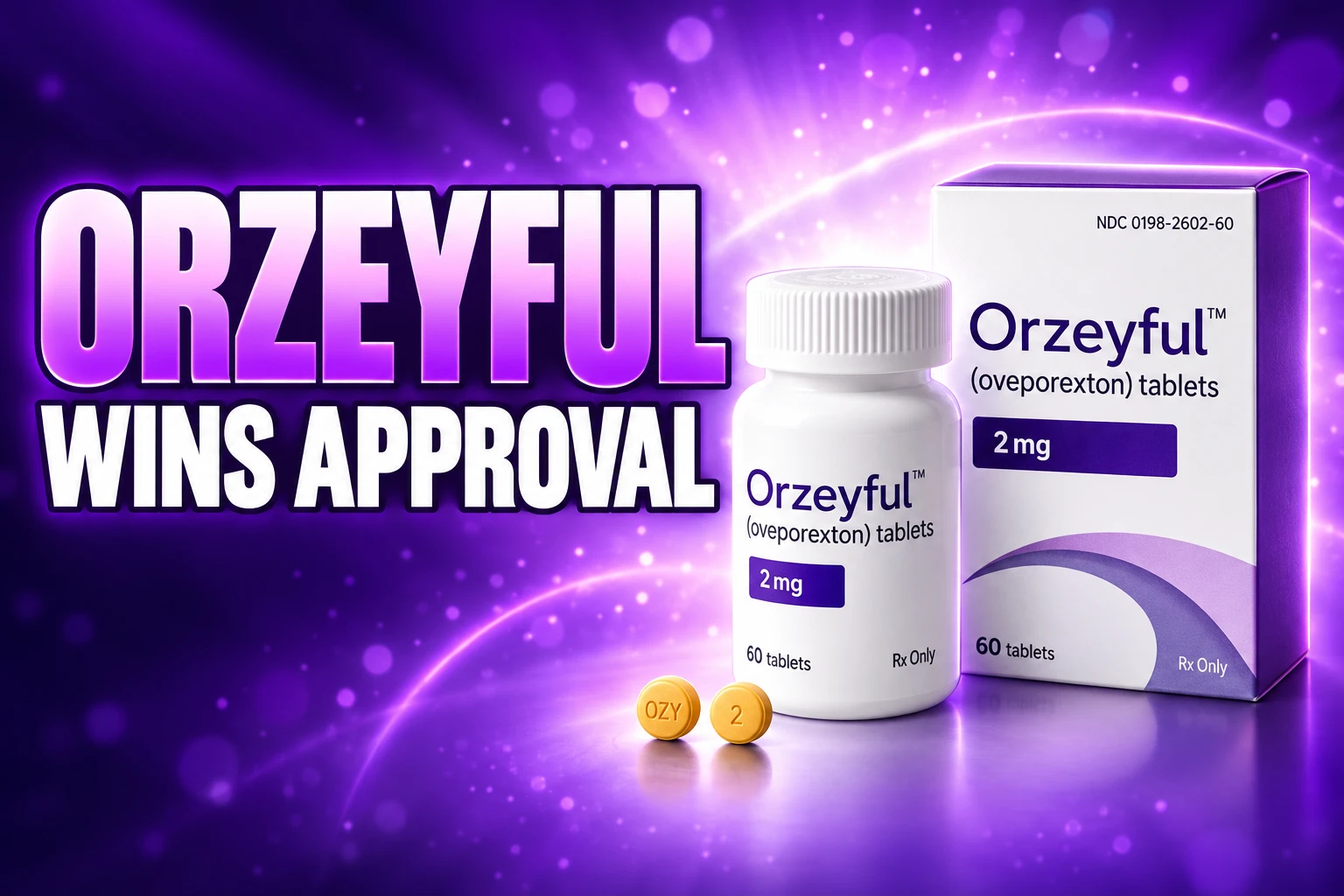
The FDA approved Orzeyful, Takeda’s twice-daily orexin pill, for adult narcolepsy type 1 on August 5, 2026. It is the first medicine built to restore a missing wake chemical rather than paper over sleepiness with stimulants or night sedatives.
The same week the late-stage data landed in a major journal, the scientists who found that chemical took a Lasker Prize, and bigger drugmakers kept spending as if a rare sleep disorder were only the first stop.
Orzeyful Restored Wakefulness in Two 12-Week Trials
Narcolepsy type 1 is driven by loss of brain cells that make orexin, a peptide that holds the line between wake, sleep and muscle tone. Takeda estimates 120,000 people in the United States live with it. They deal with crushing daytime sleepiness, cataplexy (a sudden loss of muscle tone, often after a laugh), sleep paralysis, dreamlike hallucinations and broken nights.
Until this approval, no medicine was cleared for the disorder as a whole, and none acted on orexin. Tiffany R. Farchione, director of the Division of Psychiatry in the FDA’s Center for Drug Evaluation and Research, said people had been left with drugs that only treat pieces of a lifelong condition. Orzeyful (oveporexton) is an oral orexin receptor 2 agonist, taken twice a day, and the agency called it the first drug to restore orexin signaling.
Doctors measure that claim with a Maintenance of Wakefulness Test: sit in a dim room for 40 minutes, stay awake, no reading, no talk. Emmanuel Mignot, a Stanford sleep researcher and a U.S. leader of the late-stage program, has said a typical person finds that hard and a person with narcolepsy finds it almost impossible. In two phase 3 trials of oveporexton, published September 9, 2026 in the New England Journal of Medicine, that gap moved.
HOW THE 12-WEEK STUDIES MOVED WAKE TIME
| Measure | Oveporexton | Placebo |
|---|---|---|
| Change in mean sleep latency on the wakefulness test | +14.3 to +19.8 minutes | -0.4 to -0.8 minutes |
| Change in Epworth Sleepiness Scale (0-24, normal under 10) | -9.7 to -11.8 | -1.5 to -1.7 |
| Median cut in weekly cataplexy | 79.0% to 88.8% | 27.7% to 39.1% |
First Light enrolled 168 people and Radiant Light enrolled 105, for 273 participants aged 16 to 70. They took 1 mg or 2 mg twice daily, or placebo, for 12 weeks. All active-dose groups reached the usual healthy mark of 20 minutes or more on the wakefulness test. About 97% of treated patients said their overall symptoms improved. Thomas Scammell, a sleep researcher at Beth Israel Deaconess Medical Center who consults for Takeda, Alkermes and Centessa, has said patients on the drug stayed awake more than 20 minutes, about twice as long as with medicines already on the market, and that the effect could change daily life.
First Light and Radiant Light: In two placebo-controlled trials, oveporexton improved wakefulness, reduced daytime sleepiness, and lowered the cataplexy rate among patients with narcolepsy type 1. Increased urinary frequency and transient insomnia were common. Full results:… pic.twitter.com/E2DFZXrpO4
— NEJM (@NEJM) September 9, 2026
Insomnia Drugs Already Tape This Receptor Shut
Orexin works like a key in two locks on cells in the hypothalamus. Sticking tape over those locks was the easier chemistry problem. Several insomnia pills already block the receptor and have been on the market for years. Building a key that opens it, an agonist that copies the missing peptide, took Takeda through an intravenous prototype, a candidate that injured the liver, and a molecule that had to be dosed twice a day.
Andrew Plump, Takeda’s president of research and development, has described that search as starting from a single hit in a compound library, the kind of lead most teams would not have backed. An earlier Takeda agonist, TAK-994, was pulled after liver injury in phase 2. Oveporexton is the molecule that survived.
For too long, people with narcolepsy type 1 have had to manage a complex, lifelong neuropsychiatric condition with treatments that only address pieces of it. This new drug is the first medicine that impacts the underlying biology of the disease, treating narcolepsy type 1 as a whole.
Tiffany R. Farchione, M.D., Director, Division of Psychiatry, FDA Center for Drug Evaluation and Research
Julie Flygare, 42, who was diagnosed in 2007 during law school and now runs the nonprofit Project Sleep, was in one of the trials. Off her usual medicines at screening she could barely walk. After dosing she made a joke with the same driver who had dropped her off, the kind of small happy jolt that used to buckle her knees. She has said the wakefulness felt sunnier than stimulants. Project Sleep takes drug-company funding, including from Takeda, and Flygare advised the firm on patient views in trials.
A Pipeline Aimed at ADHD, Fatigue and Type 2
Plump called Orzeyful the start of a class, not the end of one. Takeda is already testing TAK-360, a next orexin agonist, in narcolepsy type 2 and idiopathic hypersomnia, the sleep disorders where orexin levels are not wiped out the way they are in type 1. TAK-495 sits earlier in the same franchise. The company has put peak Orzeyful sales in type 1 at $2 billion to $3 billion a year.
Rivals treated that forecast as a floor. In March 2026, Eli Lilly agreed to pay $6.3 billion in cash for Centessa Pharmaceuticals, plus contingent rights of up to $1.5 billion, a package worth as much as $7.8 billion, to get cleminorexton and other orexin agonists aimed at type 1, type 2 and idiopathic hypersomnia. Alkermes is further along in type 2 than Takeda’s approved pill, which the U.S. label limits to type 1 in adults.
THE OREXIN AGONISTS NOW IN HUMAN TESTS
| Drug | Company | Targets | Status |
|---|---|---|---|
| Oveporexton (Orzeyful) | Takeda | Narcolepsy type 1 | Approved in the U.S., China and Japan |
| TAK-360 | Takeda | Type 2 narcolepsy, idiopathic hypersomnia | Phase 2 |
| Alixorexton | Alkermes | Type 1, type 2, idiopathic hypersomnia | Phase 3 |
| ALKS-7290 | Alkermes | ADHD | Phase 1 |
| ALKS-4510 | Alkermes | Fatigue in multiple sclerosis and Parkinson’s | Phase 1 |
| Cleminorexton | Lilly / Centessa | Type 1, type 2, idiopathic hypersomnia | Phase 2 / 3 |
Alkermes has posted once-daily alixorexton phase 2 results in type 1: patients started with about three minutes of wake time and reached about 24 to 28 minutes on the 4 mg, 6 mg and 8 mg doses. Its Brilliance phase 3 program in type 1 and type 2 is enrolling. Blair Jackson, the company’s chief executive, has said Alkermes has mapped 19 neuroscience areas where an orexin agonist might help.
That map is the point of the spending. Luis de Lecea, a Stanford molecular biologist on one of the 1998 discovery teams, has called sleep the low-hanging fruit. Orexin also falls in Alzheimer’s disease, Parkinson’s disease, PTSD and ordinary aging. The commercial draw is not 120,000 U.S. type 1 patients. It is attention, fatigue and neurodegeneration in people whose orexin cells are still there.
Why U.S. Patients Still Cannot Fill a Prescription
China’s National Medical Products Administration approved in China in July, on July 22, 2026, for adults and adolescents 16 and older, 14 days before the FDA. Japan followed on August 24. The U.S. label is adults only. Safety in people under 18 has not been established, even though the trials enrolled from age 16.
The FDA also sent the drug to the Drug Enforcement Administration for scheduling under the Controlled Substances Act. Takeda says that review should finish within 90 days of approval and that it expects U.S. supply through a specialty pharmacy by November 2026. The label already warns of abuse and misuse and tells doctors to watch patients with a recent history of stimulant misuse. Until DEA assigns a schedule, pharmacies cannot lawfully dispense it.
FROM PEPTIDE TO A PILL U.S. PHARMACIES STILL CANNOT FILL
- 1998: Masashi Yanagisawa at what is now the University of Tsukuba, Luis de Lecea’s Stanford group, and others identify orexin (also called hypocretin) as a wake peptide.
- February 10, 2026: The FDA accepts Takeda’s application for oveporexton and grants priority review.
- July 22, 2026: China approves Orzeyful, the first country to clear an orexin agonist.
- August 5, 2026: The FDA approves Orzeyful for adults with narcolepsy type 1 and refers it for DEA scheduling.
- August 24, 2026: Japan approves the same medicine.
- September 9, 2026: Phase 3 results appear in the New England Journal of Medicine; Yanagisawa and Mignot receive the Lasker Award for basic medical research.
- November 2026: Takeda’s target window for U.S. availability after a DEA schedule.
Takeda has not posted a U.S. list price. The Institute for Clinical and Economic Review, in a pre-approval cost-effectiveness analysis of oveporexton, put a health-benefit price benchmark of $50,400 to $59,400 a year against older combinations such as modafinil plus venlafaxine. That benchmark will matter once a sticker price exists. It is not a price.
WHAT WE KNOW
- The U.S. indication: Adult narcolepsy type 1 only, as a twice-daily tablet in 0.5 mg, 1 mg and 2 mg strengths.
- The access gate: DEA scheduling is still pending, and Takeda has pointed to specialty-pharmacy launch after that decision, aimed at November 2026.
- The other countries: China approved first, including ages 16 and up; Japan approved 19 days after the FDA.
WHAT IS UNCONFIRMED
- The schedule: No DEA class has been issued, so it is not yet known whether Orzeyful will sit with milder wake drugs or with tighter oxybate rules.
- The U.S. price: Takeda has said it will talk price at scheduling, and no list figure is public.
- Long-term brain risk: Twelve-week trials cannot show whether years of receptor agonism change the odds of other neurologic disease.
Julie Kim, Takeda’s chief executive, said the approval opens a new class and that the company will bring it to adults with type 1 as quickly as it can. Speed, in the United States, now belongs to DEA.
The Wake Signal Also Hits the Bladder
Adverse events were common. In the two phase 3 studies they showed up in 86% to 89% of people on oveporexton, against 43% to 54% on placebo. Most were mild or moderate, started within two days, and did not need extra treatment. The dropout rate for side effects was low. There is no boxed warning on the draft label Takeda circulated at approval.
WHAT SHOWED UP MOST ON THE PILL
- Transient insomnia: 60% on 2 mg twice daily and 55% on 1 mg, versus 1% on placebo; most bouts eased within a week and did not wreck daytime function the way ordinary insomnia does.
- Urinary frequency: 58% on 2 mg and 53% on 1 mg, versus 5% on placebo, a direct hit on central bladder pathways that also carry orexin receptor 2.
- Urinary urgency: 16% and 15% on the two doses, versus 1% on placebo; about half of urinary events had settled by week 12.
- Muscle enzyme spikes: Creatine phosphokinase more than five times the upper limit of normal in 11% of treated patients (21 of 196) versus 5% on placebo (4 of 76); two people with very high CPK and liver enzymes stopped the drug.
The label also flags extra saliva, a ban on strong CYP3A inhibitors, and a caution against use in severe liver disease or in people on dialysis. If insomnia lasts past seven days and hurts daytime life, the label says to cut the dose or stop. Patients are told to report unexplained muscle pain, weakness or dark urine, especially if they exercise hard.
Those bladder effects are not a random nuisance. They are the same receptor doing extra work. Anyone who wants to push orexin agonists into ADHD or MS fatigue will inherit that plumbing, along with whatever a wake signal does to mood, appetite and sleep architecture over years. Twelve weeks cannot answer that.
28 Years From Peptide to Prize
On September 9, 2026, the Albert and Mary Lasker Foundation gave its basic medical research award to Yanagisawa and Mignot, 28 years after the 1998 papers. A companion New England Journal note called their work the foundation for both the insomnia blockers and this new agonist. Yanagisawa, now 66 and at the University of Tsukuba, has said companies once told him the science was exciting and the disease, one in several thousand, was not common enough. Mignot ran the U.S. arm of the trial that just won the drug its label.
Flygare called the approval a historic moment for people who have spent years stacking stimulants and oxybates. She still cannot walk into a U.S. pharmacy and fill the prescription. The people who lack orexin were the only group in which a first agonist could be proven. The checks being written now are for everyone else.
Disclaimer: This article is news reporting on a newly approved prescription medicine and related research, and it is for information only. It is not medical advice, a treatment recommendation, or a substitute for a doctor’s judgment about narcolepsy, cataplexy, or any other sleep or neurologic condition. Readers should talk with a qualified physician or sleep specialist, and with a pharmacist, before starting, stopping, or combining any medicine named here. Approval status, DEA scheduling, trial figures, and prices are those given by the cited agencies and companies as of the dates in the piece and can change.

Ryanair Fuel Mayday Followed a Diversion Manchester Should Have Taken

Gates Pushes AI Laws He Says Will Not Slow Labs

NWLA APEX Folds Free AI Classes Into Federal Contracting

The Narcolepsy Pill That Opens a Wider Brain Bet

Treasury’s $6 Billion Buyback Leaves the 10-Year Higher

LSU Players Carry the Cost of Kiffin’s NFL Additions

A Quiet German Wiki Caught OpenAI’s Agent Swarm

Welspun’s Record US Order Is Still a Gas Export Line

Palo Alto Networks Stock Slips as the $20 Billion Bet Tightens

Carnegie Deli Reopens in the Stage Deli’s Old Shop
-
 NEWS4 weeks ago
LSU Players Carry the Cost of Kiffin’s NFL Additions
-
 NEWS3 weeks ago
A Quiet German Wiki Caught OpenAI’s Agent Swarm
-
 BUSINESS4 weeks ago
Welspun’s Record US Order Is Still a Gas Export Line
-
 BUSINESS4 weeks ago
Palo Alto Networks Stock Slips as the $20 Billion Bet Tightens
-
 LIFESTYLE3 weeks ago
Carnegie Deli Reopens in the Stage Deli’s Old Shop
-

 BUSINESS3 weeks ago
Karamtara Wins the QIB Vote as Six IPOs Open
-

 GAMING3 weeks ago
The Zelda Switch 2 Costs Extra and Includes No Game
-
 NEWS4 days ago
Gates Pushes AI Laws He Says Will Not Slow Labs