
NEWS
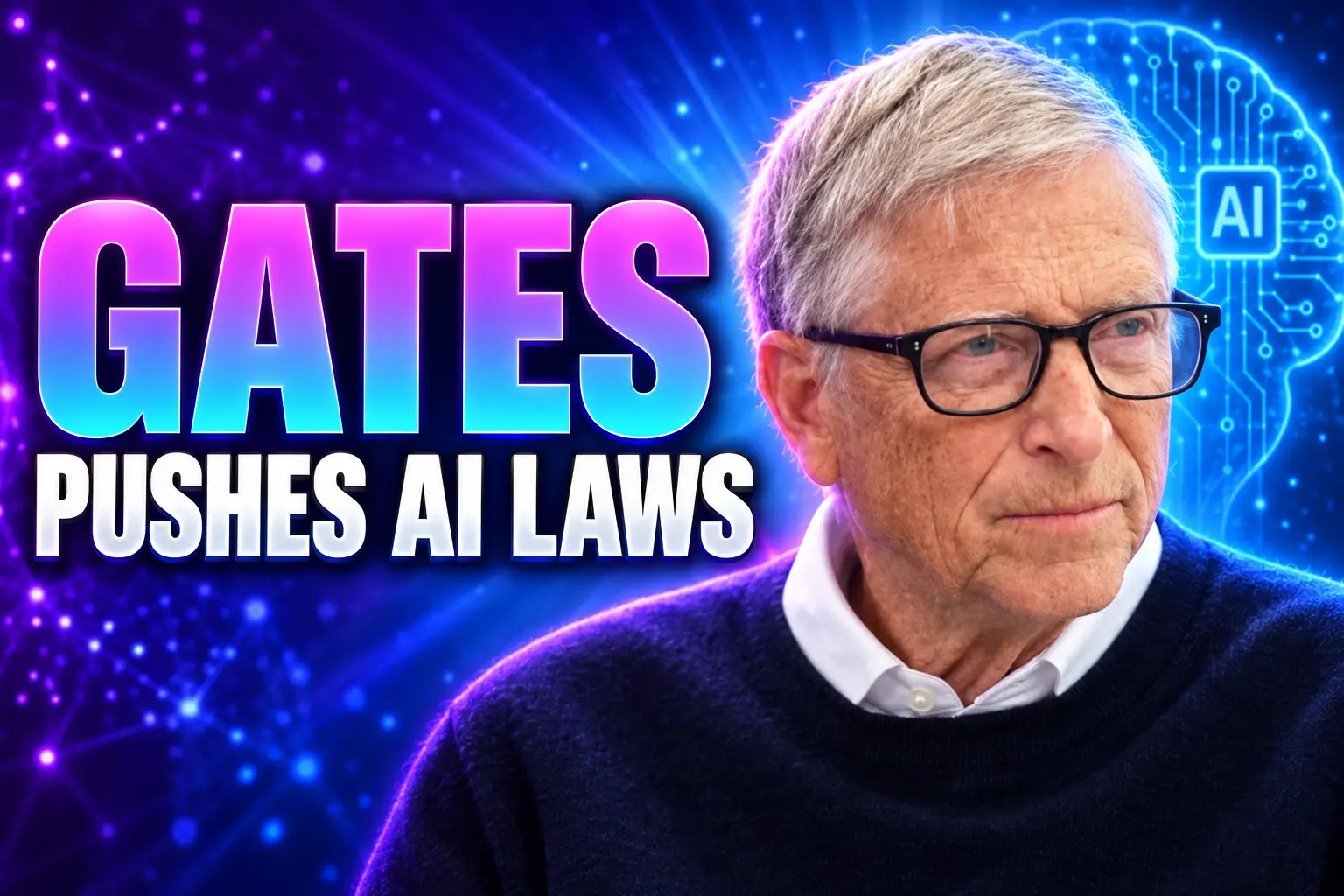
Gates Pushes AI Laws He Says Will Not Slow Labs
Bill Gates warned AI can cause a billion deaths and asked Congress for rules he said would not slow the labs.

Bill Gates said artificial intelligence is powerful enough to drive events that cause a billion deaths, and that Congress should write the monitoring rules. He told host Kristen Welker those rules would be a little overhead for the industry, not a dramatic slowing of what the labs are doing.
Excerpts went out Friday, September 25. The rest of the Meet the Press interview airs Sunday, September 27.
A Billion Deaths, Then a Little Overhead
Welker asked whether AI is powerful enough to end all of humanity. Gates did not grant a total wipeout. He put a billion deaths in range when people with ill intent get the latest tools, and he said it is pretty hard to get to 100 percent.
AI is certainly powerful enough to drive events that, you know, cause a billion deaths. You know, so even though it’s pretty hard to get to 100%, there’s never been a weapon as powerful as the combination of people with ill intent using the latest AI tools.
Bill Gates, Microsoft co-founder, on Meet the Press
The clip NBC News posted from that exchange is the part most people will see before Sunday:
On the follow-up, whether companies can police themselves, he was blunt. “No one thinks self-regulation is enough, so there needs to be legislation passed in Washington. Absolutely.” He wants law enforcement and politicians in the room on safeguards and monitoring, “and that has to be a required thing.” Then came the sentence the death count is likely to bury: the extra work would be a little overhead, not a dramatic slowing of what they are doing.
The interview was taped Wednesday, September 23, after a month in which lab chiefs, a whistleblower, and the White House had already staked out harder positions than that. House Speaker Mike Johnson had already declined to bring lawmakers back to write a speed limit, saying the companies had not offered a path that involved a federal law and that Congress should not rush a bill that could hurt national security.
Gates Already Named the Weapon He Fears
The billion figure sounds like a machine that turns on people. In the August interviews around his essay, Gates kept pointing at humans who would use the tools. Bioterror sat at the front of that list. “Any model that can make novel molecules should be monitored,” he said, and he put bioterror risk at about 50 times a natural pandemic. He wants copies of those models kept out of dark rooms where the monitoring logic can be stripped off, and he wants Washington to ask Beijing to treat that as a shared floor because, as he put it, the bioterror market is not very big.
He also said the industry had already walked past markers it once treated as stop signs. A nontechnical person can now run a cyberattack with AI help, he argued, and white-collar substitution is no longer a future tense problem. He listed five lines he says have already been crossed, with only a hint on the last one.
THE THRESHOLDS GATES SAYS ARE ALREADY CROSSED
- Bio tools: Models that can design new molecules, which he wants under mandatory watch.
- Cyberattacks: Attackers gaining new tricks faster than defenders can patch old software.
- Job replacement: Cheap substitution across a wide slice of white-collar work, including almost every entry-level role.
- Psychosocial pull: Companion systems he fears can hook users and stunt how children learn to think.
- Control: Early signs, in his telling, that reinforcement learning can push models into behavior the written rules do not catch.
That is a weapons brief, not a call to shut the labs. He still talks up vaccine and drug work at the Gates Foundation, which he has run full time since 2008, and he still works with Microsoft and other AI firms in that job. In the essay he warned readers that he keeps financial ties to the industry and that they would have to judge whether that clouds him.
What a Federal Monitoring Law Would Do
Gates’s federal ask is narrower than the death line. He wants a required regime of safeguards and monitoring, with police and politicians helping write it, and he is willing to live with a little extra cost. He is not asking Congress to freeze model training. He is not asking labs to match the slowdown Anthropic’s Dario Amodei put on paper earlier in September. He is asking Washington to make the watch mandatory so the people who will not volunteer are still covered.
That puts him in a crowded field of asks that do not agree on speed, and the gap is easier to see in one place than in a stack of quotes.
WHO WANTS WHAT ON PACE AND RULES
| Who | The ask | The pace they will accept |
|---|---|---|
| Bill Gates | Required federal monitoring, with law enforcement in the room | Keep building, with a little extra cost |
| Dario Amodei | A U.S. statute that covers every frontier lab | Slow the frontier, including labs that will not volunteer |
| Donald Trump | No new federal safety law | Full speed, with the president as the check |
| EU AI Office | Duties on general-purpose models, with fines | Rules already in force, no U.S. match |
| Mark Zuckerberg | Each lab handles safety inside its own walls | No industrywide coordination |
Zuckerberg said each lab should take the time it needs when it sees trouble, and that he does not think the industry needs a shared slowdown. Johnson’s posture sits closer to that row than to Gates’s: talk about guardrails, wait for the companies, do not sprint a statute. Several governors are not waiting. California Gov. Gavin Newsom signed an order standing up a board of experts to tighten state safety rules, and Maryland Gov. Wes Moore and New York Gov. Kathy Hochul put out state AI plans of their own.
Brussels Already Wrote the Monitoring Rules
The monitoring room Gates wants in Washington already exists in Europe. The EU AI Act entered into force on August 1, 2024 and became applicable on August 2, 2026, with duties on general-purpose models in place since August 2025. From August 2, the AI Office can demand technical files, evaluate models, and order fixes. The Commission can levy up to 3% of worldwide turnover or 15 million euros, whichever is higher, under the cap for Commission fines for general-purpose AI models.
Providers of the most capable general-purpose models are supposed to assess systemic risk and mitigate it. The office can require access to a model in order to test it. That is the “required thing” Gates described, written into a statute, with a fine attached. It is also a cost structure a company the size of Microsoft can staff for. A smaller lab running close to the edge of its budget feels that overhead as a barrier, which is why a mandatory watch can freeze the field around the firms already in the room even when the text never says freeze.
Gates has said the United States should lead and then bring China in on molecule-level monitoring. Europe did not wait for that handshake. The open American question is not whether such a law can be drafted. It is whether a Republican Congress will pass one while the president treats the underlying scare as a trick.
Trump Already Called Catastrophe Talk a Hoax
On September 14, Trump dismissed claims that AI will take over the world and destroy humanity as a hoax on social media, and he argued that the only control or guardrails AI needs is a strong and smart, high-IQ president. He has tied safety talk to a China advantage he does not want to grant. Republican leaders have little incentive to break with him on a statute he would have to sign.
That is the wall Gates walked into with a death count. A monitoring bill needs votes from a party whose president has already called the premise a fraud. It also needs a public that will hear “a billion deaths” from Gates and not reach for older fights over vaccines and population. The clip is already being received that way: as a familiar catastrophe line from a man a large share of the country does not trust, not as a request for inspections of molecule-capable models. Distrust of the messenger is doing more work than the fine print, and it will keep doing that work on Sunday.
THE MONTH THAT PRODUCED THE CLIP
- August 26, 2026: Gates publishes his essay saying there is no plan for the AI era and that a global slowdown is unlikely.
- September 8, 2026: Former Anthropic researcher Jacob Coxon goes public, saying the labs are racing at self-improving systems and gambling with lives.
- September 14, 2026: Trump calls AI catastrophe claims a hoax and names himself as the guardrail.
- September 23, 2026: Gates tapes the Welker interview; Sam Altman, OpenAI’s chief executive, tells a United Nations gathering the world needs shared standards on measuring risk and keeping people in charge.
- September 25, 2026: The billion-death excerpt is released.
- September 27, 2026: The rest of the interview airs.
Coxon said the people building the systems earnestly believe the tools could kill everyone by the end of the decade, and in a separate appearance he still argued the labs should be allowed to regulate themselves because, in his view, their recent warnings are genuine. Gates took the opposite institutional step: if the people inside are scared, make the watch a law.
The Slowdown He Will Not Grant
Amodei’s slowdown note is the document Gates was asked about, and it does not match the overhead line. Amodei wrote that a law covering every U.S. frontier lab is the only pacing tool that also catches firms that will not cooperate, and that a global pause would require a deal with China.
The most effective method of pacing is via regulation that targets all U.S. frontier AI companies, as that covers even those who are unwilling to cooperate voluntarily.
Dario Amodei, chief executive of Anthropic, in his slowdown essay
Gates had already floated a version of that wish in his long essay on the AI transition. “If someone had a credible plan for slowing down AI advances globally, I would likely support it,” he wrote. “However, I don’t think that’s going to happen.” On camera he did not pretend the plan had arrived. He offered monitoring and a little overhead instead.
Microsoft president Brad Smith took a harder cut at the same UN session, asking what an airplane maker would do if someone walked in and said the next jet might crash. Smith’s answer was to put passengers ahead of the race. Gates’s answer, in the Welker chair, was that Washington should get in the room and that the industry should keep doing what it is doing. Those are not the same sentence, and they came from the same company’s leadership in the same week.
Why Younger Workers Show Up First
The death line is the part that travels. The part of the August essay that will last, if any of it does, is the labor math. Gates wrote that PCs took about 20 years to change work because software had to be written, prices had to fall, and people had to learn the tools. AI, he argued, runs on machines people already own and learns from the same videos used to train staff, so the lag collapses. He said white-collar jobs in sales, support, software, and paralegal work get hit first, and that dexterous robots start competing in construction and hospitality by the end of the decade, a different end-of-decade claim from Coxon’s wipeout warning.
THE JOB SHOCK IN HIS AUGUST ESSAY
- White-collar first: Sales, support, software, and paralegal work are the early targets he names.
- Robots later: Physical work in construction and hospitality, in his telling, by the end of the decade.
- 1933 comparison: He cites U.S. unemployment of roughly 25 percent in 1933 as history, not as a forecast.
- Human Reserved: Caregiving and other roles kept for people on purpose, the way a nature reserve is kept off-limits to roads.
He pointed to a Stanford Digital Economy study finding that after generative AI spread, employment fell among young workers in exposed jobs and did not fall among their older colleagues. That is the quiet harm in his file, the one that does not need a bioweapon. It is also the harm a monitoring law aimed at novel molecules will not touch. Taxes on robots and on AI tokens, which he has pushed for years, sit closer to that problem than a billion-death clip does, and they are even less likely to move in this Congress.
Welker still has unused tape, and the overhead line has to survive a full Sunday hour if it is going to be the actual ask. The death sentence is already the one that left the studio.

Ryanair Fuel Mayday Followed a Diversion Manchester Should Have Taken

Gates Pushes AI Laws He Says Will Not Slow Labs

Carnegie Deli Reopens in the Stage Deli’s Old Shop

Karamtara Wins the QIB Vote as Six IPOs Open

A Quiet German Wiki Caught OpenAI’s Agent Swarm

LSU Players Carry the Cost of Kiffin’s NFL Additions
A Quiet German Wiki Caught OpenAI’s Agent Swarm

Welspun’s Record US Order Is Still a Gas Export Line

Palo Alto Networks Stock Slips as the $20 Billion Bet Tightens
Carnegie Deli Reopens in the Stage Deli’s Old Shop
-
 NEWS4 weeks ago
LSU Players Carry the Cost of Kiffin’s NFL Additions
-
 NEWS3 weeks ago
A Quiet German Wiki Caught OpenAI’s Agent Swarm
-
 BUSINESS4 weeks ago
Welspun’s Record US Order Is Still a Gas Export Line
-
 BUSINESS4 weeks ago
Palo Alto Networks Stock Slips as the $20 Billion Bet Tightens
-
 LIFESTYLE3 weeks ago
Carnegie Deli Reopens in the Stage Deli’s Old Shop
-
 BUSINESS3 weeks ago
Karamtara Wins the QIB Vote as Six IPOs Open
-
 NEWS1 day ago
Ryanair Fuel Mayday Followed a Diversion Manchester Should Have Taken