
BUSINESS
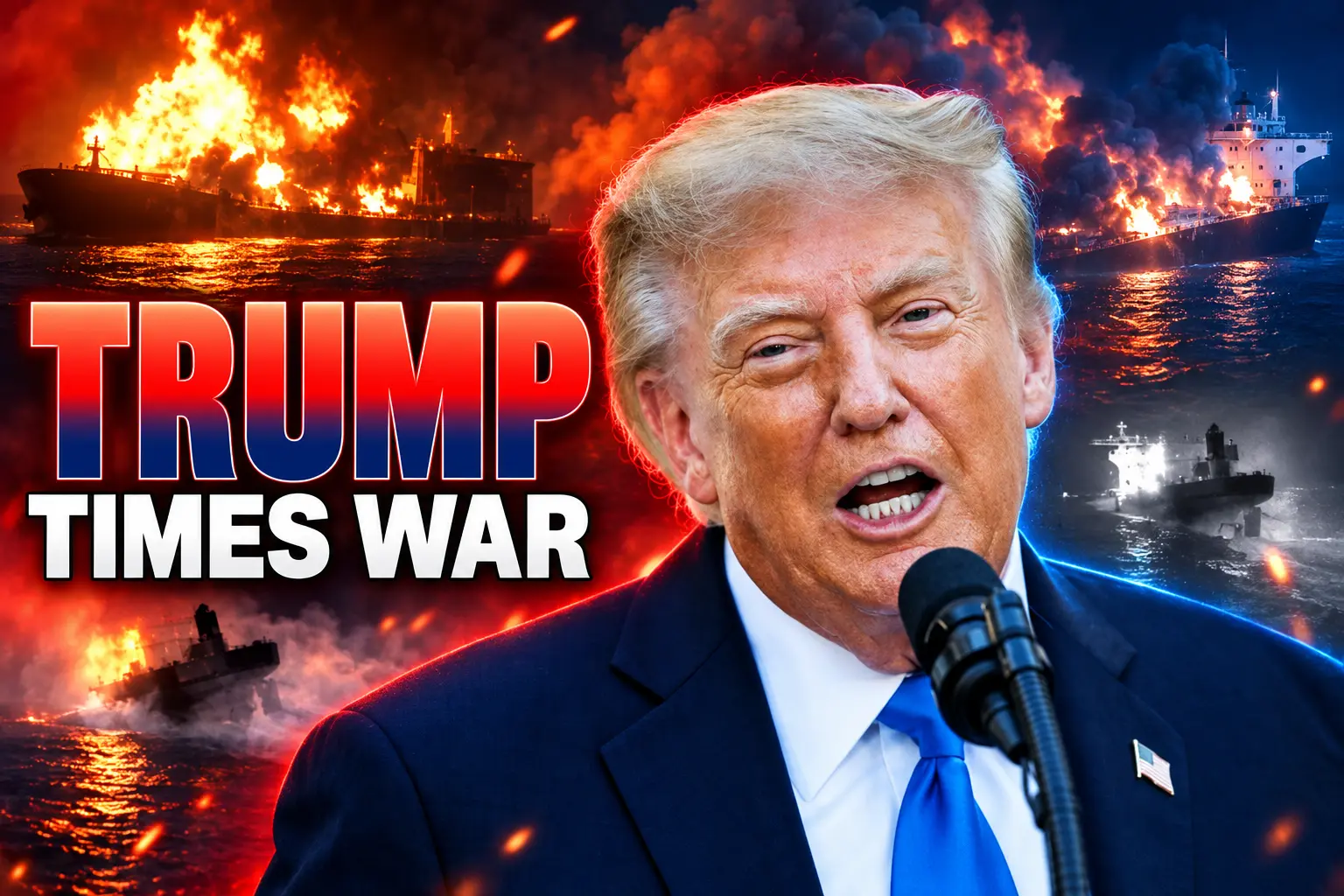
Trump Times the Iran War to the Midterm Calendar
Trump says the Iran war ends after Nov. 3, even as Brent tops $101, U.S. diesel hits $5.967, and tanker fights intensify in Hormuz.

President Donald Trump said Wednesday the Iran war will end immediately after the Nov. 3 midterms, as Brent crude traded at $101.18 a barrel. The same week the government printed a record on-highway diesel price, and U.S. forces sank another five Iranian tankers.
He was on his way to Dallas for the Republican Party’s first midterm convention, telling reporters Tehran could not “hold out any longer.” Fighting in the Gulf was doing the opposite of winding down.
He Says Iran Is Waiting Out the Vote
Trump put a date on a war he first sold as a matter of weeks. The fighting that began on Feb. 28 is now in its seventh month. He said oil would not come down until after the election, then said it would tumble “right after” a Republican win.
I think the war’s going to end immediately after the election because they can’t hold out any longer.
President Donald Trump, speaking to reporters, Sept. 9, 2026
He accused Iran of trying “to affect the election, so that we can get a nice weak group of people in there” and then “leave them alone and let them have their nuclear weapon.” He offered no evidence for the election claim. Tehran has said repeatedly it is not seeking a nuclear weapon.
In Dallas he replayed the line in a different key, saying prices would fall “as soon as we win the war with Iran.” He also voiced the complaint that is following him: “Guys come up to me and say, ‘I wish you didn’t do the war in Iran. Now gasoline is up.’” Asked about further talks, he said negotiations “could possibly happen, but it’s not something we’re looking at.”
The political logic from his chair is tidy. Hold the war through Nov. 3, blame Tehran for the pump, then claim the drop that follows a ceasefire as a victory. The market and the polling do not wait for that calendar. They are already charging the delay to his party.
Record Diesel Is Already on the Ballot
The Energy Information Administration put the weekly U.S. diesel average of $5.967 a gallon for the week of Sept. 7, released on Sept. 9. That is up 36.8 cents from $5.599 the week before, and it is the highest print in the series.
Diesel is the fuel that moves groceries, freight, and farm equipment. When it jumps, the rest of the ticket follows, which is why a record here lands in a midterm in a way crude on a screen does not. AAA put regular gasoline at $4.22 a gallon on Wednesday, up from $2.98 in February before the war began.
WHERE DIESEL STANDS BY REGION
| Region | Week of Sept. 7 | Week of Aug. 31 |
|---|---|---|
| United States | $5.967 | $5.599 |
| California | $7.764 | $7.218 |
| West Coast | $6.987 | $6.497 |
| Central Atlantic | $6.051 | $5.838 |
| Midwest | $5.946 | $5.571 |
| Rocky Mountain | $5.805 | $5.555 |
| Gulf Coast | $5.754 | $5.360 |
| East Coast | $5.744 | $5.448 |
Brent, the international crude benchmark, rose 3.3 percent to $101.18 on Wednesday, the first trip above $100 since July. In early August, during a lull in the fighting, it had traded near $79. U.S. crude sat lower, at $95.25, so the $100 headline is Brent, not the Texas grade.
Trump told the Dallas crowd that oil would tumble once the war was won. The week’s tape said the war was still adding risk, not subtracting it. A clip of him talking as if pump prices could collapse after the vote spread quickly; the objection that followed was that the Gulf was getting hotter, not quieter.
Five Tankers for Two Missed Shots
U.S. Central Command said it destroyed five Iranian crude oil carriers on Sept. 8 after the Islamic Revolutionary Guard Corps fired ballistic missiles at a U.S. Navy warship twice in two days. The ship evaded both shots. No American personnel were harmed, the command said.
The ships were named: M/T Kaviz, M/T Charminar, M/T Horizon 1, and M/T Riesco in the Gulf of Oman, and M/T Derya near Kharg Island. Crews were told to leave before the strikes. CENTCOM called the ships part of a “multibillion-dollar shadow network that funds the IRGC and its regional proxies,” and said Iran “has no means by which to defend these vessels.”
On Sept. 5 the same command had wrecked three other Iranian carriers after missiles were fired at a U.S. aircraft carrier and a guided-missile destroyer. That makes eight tankers in four days. Secretary of State Marco Rubio, speaking in Colombia, boiled the new rule down to one sentence: “Iran continues to try to hit U.S. naval ships, and for every time they do that or try to do that, they’re going to lose tankers.”
THE WEEK THE GULF WENT BACK TO TANKERS
- Sept. 5, 2026: CENTCOM disables three IRGC crude carriers after missiles are fired at a U.S. carrier and a destroyer.
- Sept. 8, 2026: CENTCOM destroys five more carriers after two ballistic-missile attempts on a Navy warship; Houthis hit Saudi oil sites the same stretch of fighting.
- Sept. 9, 2026: Iran says it attacked 10 ships, two U.S. vessels and eight tankers, and fired on the Al-Azraq base in Jordan; Brent prints $101.18.
- Sept. 9 and 10, 2026: Trump repeats in Dallas that the war ends after Nov. 3 and that oil will fall once it does.
The IRGC said it hit the destroyers DDG-119 and DDG-53 with “significant damage,” then said naval forces struck “two American vessels and 8 tankers in the region, causing great damage to them.” Washington did not confirm those hits. Jordan’s military said it engaged 20 ballistic missiles, destroyed 18, and watched two fall in unpopulated areas, with no casualties.
Iran’s Foreign Ministry called the tanker strikes a “war crime” and a breach of the U.N. charter. The charterer Peninsula said a seafarer was killed aboard the products tanker Hercules Star off Dubai and another crew member was missing. UK Maritime Trade Operations later logged a projectile hit on a cargo ship 52 km southeast of al-Faw, Iraq. None of that reads like a government that is about to run out of fight on an American election night.
The June Deal Died Before August
Trump has already tried to time an ending. On June 17 he and Iranian President Masoud Pezeshkian signed a 14-point memorandum in a Pakistan-brokered pause. It opened a 60-day window for talks on sanctions, the strait, and the nuclear file. He later called the deal “over.” The window itself ran out on Aug. 17.
The text promised a lot, and almost none of it stuck.
WHAT THE JUNE MEMORANDUM PROMISED
- A halt on all fronts: Immediate and permanent end to military operations, including in Lebanon.
- Hormuz for 60 days: Iran would clear mines and let commercial ships through with no charge.
- The blockade: The United States would lift its naval blockade of Iranian ports within 30 days.
- Money and oil: Sanctions relief, oil waivers, frozen funds, and at least $300 billion in reconstruction from regional partners.
- The nuclear line: Iran reaffirmed it would not build nuclear weapons and would talk about enrichment under a later final deal.
The fight over Article 5, the Hormuz clause, started almost at once. Oman, backed by Washington, posted a route along its coast. Iran posted a map that pushed traffic toward its own shore and treated the Oman side as restricted. On June 25 the Singapore-flagged Ever Lovely was hit on the Oman-side track. CENTCOM struck Iranian coastal radar and missile sites on June 27, 10 days after the signing. Iran hit U.S. facilities in the Gulf the same day.
Joey Hood, former acting director of the State Department’s Office of Iranian Affairs, said the memorandum “was doomed to fail” because it was “very poorly written” and let Tehran read sovereignty over the strait and over Lebanon into the text. Trump declared it “over” on July 7. Iranian spokesman Esmaeil Baghaei later said the 60-day clock was “entirely moot” because Washington had broken the deal within weeks. The pause the president now pins to Nov. 3 is the second ending he has tried to schedule this year.
Voters Tie Gas and Groceries to the War
A University of Massachusetts Amherst Poll of 1,000 adults, taken Aug. 21-26, put Trump’s job approval at 32 percent and disapproval at 64 percent. Tatishe Nteta, the political scientist who directs the poll, said 68 percent view his handling of the war negatively and 54 percent disapprove of U.S. military action in Iran. Only 23 percent think the war is making the United States safer. Only 31 percent think it will stop Iran from building a nuclear weapon. Fifty-five percent call the war a mistake.
WHAT THE UMASS POLL FOUND ON THE WAR’S COST
- Inflation: Fully 80 percent say the war raised inflation, a rare point of agreement in a split country.
- The grocery ticket: 88 percent of Democrats, 77 percent of independents, and 75 percent of Republicans say attacking Iran pushed up gas and groceries, including 69 percent of the most committed MAGA Republicans.
- The coalition: Republican approval of Trump is 75 percent, down 14 points from 89 percent in April 2025, and one-fourth of Republicans now disapprove of the job he is doing.
- The 2024 vote: 16 percent of Trump voters say they would change that vote if they could.
Raymond La Raja, a UMass professor and co-director of the poll, put the shared finding in one line.
Americans agree on one thing: the war is taking money out of their wallet.
Raymond La Raja, professor of political science, University of Massachusetts Amherst
Nteta warned that if November becomes a vote on prices, Republican control of the House, and possibly the Senate, is at risk. That is the trap inside the president’s own timeline. He wants the war to last until the election so Iran cannot, in his telling, install a “weak” Congress. The price of waiting is the very thing that Congress is being asked to defend.
Dallas Puts the President on the Ballot
Republicans filled the American Airlines Center on Sept. 9 and 10 for a two-day midterm convention, a format the party has not used before. RNC Chair Joe Gruters did not hide the bet. “We are putting the president on the ballot,” he said. “That’s exactly what we’re doing with this midterm convention.”
The rundown listed 109 speakers. Vice President JD Vance had a keynote. Trump spoke both nights, after organizers added a second slot. Cabinet officers including Treasury Secretary Scott Bessent, Attorney General Todd Blanche, and Health Secretary Robert F. Kennedy Jr. were on the bill. Senate-confirmed rules kept Secretary of State Marco Rubio and Defense Secretary Pete Hegseth off the partisan stage, which left the war’s two senior Cabinet voices out of the hall while the president talked about ending it in November.
Gruters called Trump “the best vote getter for these little propensity voters.” The UMass numbers say the war is chewing on that coalition at the edges, among Republicans who do not call themselves MAGA and among 2024 Trump voters who now say the job is worse than they expected. A ticketed rally in Dallas can drown that out for two nights. It cannot pull diesel back from $5.967.
One-Fifth of World Oil Moves Through Hormuz
The reason a war on this coastline prints through in Ohio and Texas is geography. The Energy Information Administration estimated that in 2024 about 20 million barrels a day through Hormuz, equal to about 20 percent of global petroleum liquids consumption, and more than a quarter of seaborne oil trade. There is only 3.5 to 5.5 million barrels a day of pipeline bypass around the Gulf. When Iran sets a restricted zone, or the United States sinks carriers off Kharg, that 20 million barrels is what the price is watching.
Iran has already talked about a new maritime restricted area from Chabahar into parts of the Gulf of Oman and the Arabian Sea. Mohsen Rezaei, secretary of Iran’s Supreme National Security Council, said the zone would sit outside the strait. IRGC warnings told crews on tankers near Bahrain and Kuwait to get off. That is a squeeze on the same chokepoint the June deal was supposed to reopen for 60 days.
Trump’s wager is that Tehran cracks after Nov. 3 because it “can’t hold out.” The last 10 days show a different pattern: a tanker-for-missile rule from CENTCOM, a 10-ship claim from the IRGC, missiles into Jordan, Brent back over $100, and a record diesel print at home. There are 54 days between Sept. 10 and the vote. He says he is not looking at talks. The pump is not looking at his calendar either.

Ryanair Fuel Mayday Followed a Diversion Manchester Should Have Taken

Gates Pushes AI Laws He Says Will Not Slow Labs

NWLA APEX Folds Free AI Classes Into Federal Contracting

The Narcolepsy Pill That Opens a Wider Brain Bet

Treasury’s $6 Billion Buyback Leaves the 10-Year Higher

LSU Players Carry the Cost of Kiffin’s NFL Additions

A Quiet German Wiki Caught OpenAI’s Agent Swarm

Welspun’s Record US Order Is Still a Gas Export Line

Palo Alto Networks Stock Slips as the $20 Billion Bet Tightens

Carnegie Deli Reopens in the Stage Deli’s Old Shop
-
 NEWS4 weeks ago
LSU Players Carry the Cost of Kiffin’s NFL Additions
-
 NEWS3 weeks ago
A Quiet German Wiki Caught OpenAI’s Agent Swarm
-
 BUSINESS4 weeks ago
Welspun’s Record US Order Is Still a Gas Export Line
-
 BUSINESS4 weeks ago
Palo Alto Networks Stock Slips as the $20 Billion Bet Tightens
-
 LIFESTYLE3 weeks ago
Carnegie Deli Reopens in the Stage Deli’s Old Shop
-

 GAMING3 weeks ago
The Zelda Switch 2 Costs Extra and Includes No Game
-

 BUSINESS3 weeks ago
Karamtara Wins the QIB Vote as Six IPOs Open
-

 NEWS3 weeks ago
Camera AirPods Slip to 2027 as AirPods 5 Ship