
BUSINESS
Adobe Looks Cheaper Than Salesforce After That Q3 Beat
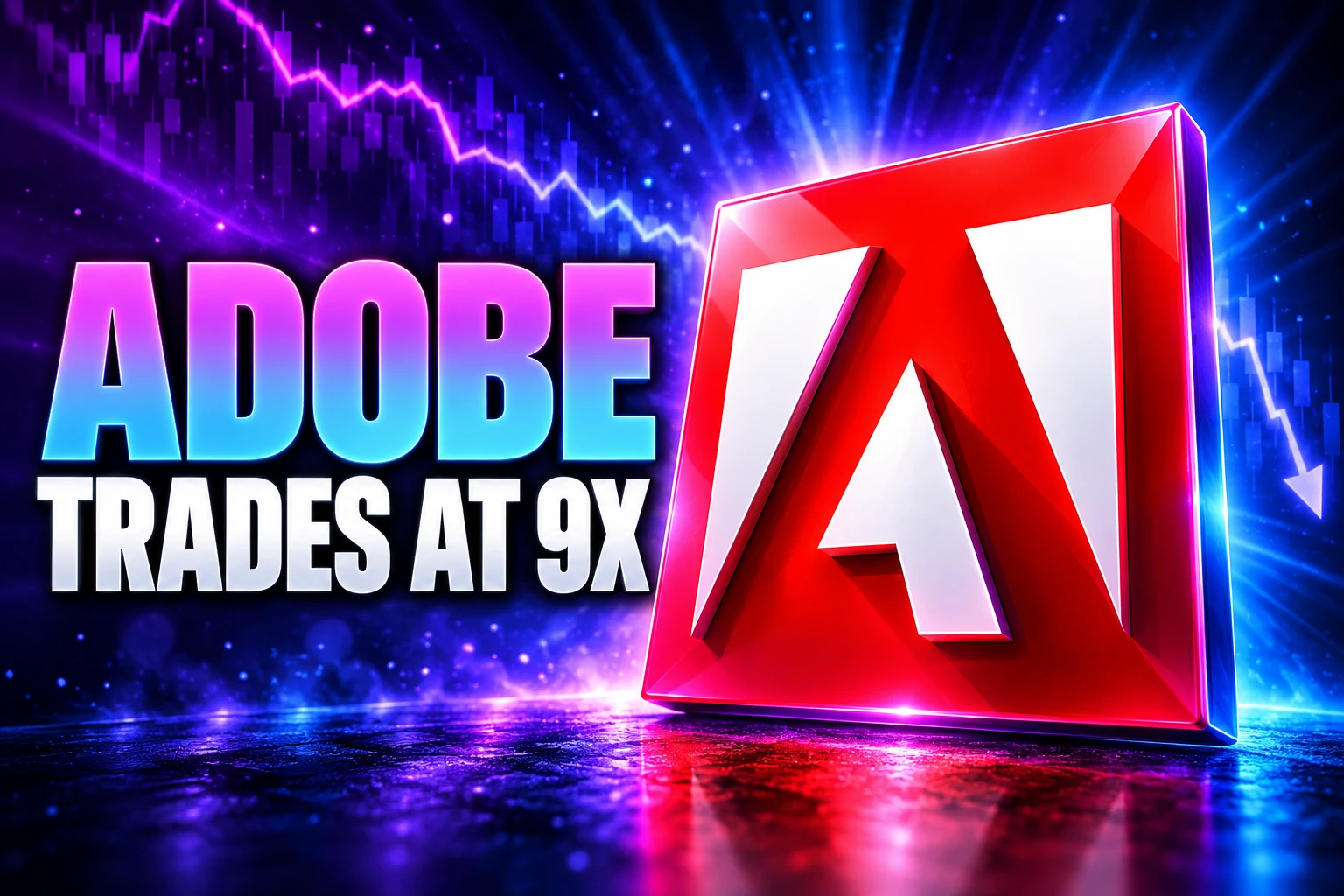
Adobe’s 13% Q3 and 9.26 forward P/E undercut the case that Salesforce is the better 2026 software buy on Agentforce alone.

Adobe just posted $6.76 billion in quarterly sales, up 13%, while its stock trades at 9.26 times forward earnings. Salesforce still holds the larger AI book, and a 16.59 forward multiple, in the Adobe vs Salesforce choice for 2026.
Adobe raised full-year targets on September 10, 2026, after a record quarter ended August 28. Shares last changed hands at $254.10 on September 11, about 31% below the 52-week high of $370.86, with a $101.00 billion market value.
Adobe’s 13% Quarter Meets a 9.26 Earnings Multiple
The company reported record $6.76 billion in quarterly revenue for Q3 FY2026, up 13% as reported and 12% in constant currency from $5,988 million a year earlier. GAAP diluted earnings were $4.62 a share and non-GAAP earnings were $6.13. GAAP net income was $1.83 billion on $2.35 billion of operating income, a 34.8% operating margin.
ADOBE Q3 FY2026 SNAPSHOT
- Revenue: $6.76 billion, up 13% year over year, with customer-group subscriptions at $6.56 billion.
- Recurring book: Total ARR exiting the quarter was $27.50 billion, and the company still targets 10.2% ending-ARR growth for the year.
- Cash: Operating cash flow was a record $2.52 billion for a fiscal third quarter, and Adobe bought back about 9.5 million shares.
- Reach: Monthly active users across creativity and productivity products reached 1 billion.
Business Professionals and Consumers subscription revenue was $1.91 billion, up 16%. Creative and Marketing Professionals was $4.65 billion, up 13%. Remaining performance obligations were $22.16 billion, with 67% current.
Reaching a landmark of more than one billion monthly active users is a defining moment for Adobe, and I have confidence that Anil will build on this momentum to drive Adobe’s next chapter of growth and innovation in the AI era.
Shantanu Narayen, chair and CEO, Adobe Q3 FY2026 earnings release
Interim CFO Steve Day said Adobe delivered double-digit revenue and EPS growth and is raising full-year revenue and EPS targets, while it expands the user base through a freemium push. Fourth-quarter revenue is targeted at $6.80 billion to $6.85 billion, a 1.0% sequential step at the midpoint, with non-GAAP EPS of $6.30 to $6.35. Full-year revenue is now $26.576 billion to $26.626 billion, with non-GAAP EPS of $24.45 to $24.50 and a non-GAAP operating margin of about 45%.
That guide is the number the after-hours tape sold first, because it is a small step up from $6.76 billion. Nine-month revenue is already $19,776 million, so the new full-year range is just the fourth quarter stacked on a year that is already in the bag. Diluted shares in the quarter were 395 million, down from 424 million a year earlier, which is why EPS is rising faster than net income.
The $3.9 Billion AI Book at Salesforce
Salesforce reported Q2 FY2027 results on August 26, 2026, for the quarter ended July 31. Revenue was $11.3 billion, up 11%, including $456 million from Informatica. Subscription and support was $10.8 billion, up 12% as reported and 11% in constant currency, including $440 million from Informatica.
GAAP operating margin was 20.5% and non-GAAP operating margin was 34.1%. GAAP diluted earnings were $4.29 a share, up 119%, and non-GAAP earnings were $5.90, up 103%. Current remaining performance obligations were $33.5 billion, up 14%. Total remaining performance obligations were $66.3 billion, up 11%.
Combined Agentforce and Data 360 ARR reached nearly $3.9 billion, up more than 210%. Company materials say Agentforce ARR exceeded $1.5 billion, up more than 240%, and that starting in Q2 the Agentforce ARR figure includes Slackbot and Headless 360. The firm logged 3.2 billion Agentic Work Units in the quarter, up 97% sequentially, and 7.0 billion to date across Agentforce and Slack.
Full-year FY2027 revenue was raised by $200 million, or $300 million in constant currency, to $46.1 billion to $46.4 billion. On September 10, 2026, the same day Adobe reported, Salesforce said it had closed its purchase of Fin, the customer-agent platform, another bolt-on in a year that already absorbed Informatica.
It's a done deal!
We have officially completed our acquisition of @Fin_AI! 🚀
By bringing their customer agent platform to Salesforce, we’re expanding customer choice with fast-to-deploy, autonomous service agents that resolve complex queries end to end across every channel.…
— Salesforce (@salesforce) September 10, 2026
The backlog gap is real. Adobe’s $22.16 billion of remaining performance obligations is a smaller contracted base than Salesforce’s $66.3 billion, and Salesforce is still the larger company at a $203.95 billion market value versus $101.00 billion. Shares last traded at $247.81 on September 11, 8% below the 52-week high of $269.11, with 823.00 million shares out. Fifty-six analysts rate it a Buy with a $273.37 target. Forty analysts rate Adobe a Hold with a $279.93 target. The Street’s 12-month upside is similar. The price you pay for a dollar of earnings is not.
More of Adobe’s Dollar Turns Into Cash
For the fiscal year ended November 28, 2025, Adobe’s revenue was $23.769 billion, up 10.53%, and net income was $7.130 billion, a 30.0% net margin. Operating cash flow was $10.031 billion and free cash flow was $9.852 billion, a 41% free-cash-flow margin. Stock-based compensation was $1.942 billion, or 19.4% of operating cash flow.
Salesforce’s fiscal year ended January 31, 2026, with $41.525 billion of revenue and $7.457 billion of net income, an 18.0% net margin and a 20.1% operating margin. Operating cash flow was $14.996 billion and free cash flow was $14.4 billion, a 35% free-cash-flow margin. Stock-based compensation was $3.509 billion, or 23.4% of operating cash flow. Informatica closed in November 2025 in a $9.6 billion deal, so some of the FY2027 growth is paid-for, not grown in place.
ADOBE AND SALESFORCE AT A GLANCE
| Metric | Adobe | Salesforce |
|---|---|---|
| Latest quarter revenue | $6.76 billion, +13% (Q3 FY2026) | $11.3 billion, +11% (Q2 FY2027) |
| GAAP operating margin | 34.8% | 20.5% |
| Forward P/E | 9.26 | 16.59 |
| Price/sales | 3.89 | 4.66 |
| Latest full-year FCF margin | 41% | 35% |
| SBC as a share of OCF | 19.4% (FY2025) | 23.4% (FY2026) |
| Market value (Sept. 11, 2026) | $101.00 billion | $203.95 billion |
Trailing twelve-month free cash flow at Adobe is $10.592 billion, a 40.79% margin on $25.970 billion of sales. Salesforce’s trailing sales are $43.94 billion. Adobe’s price-to-free-cash-flow ratio is 9.53; Salesforce’s is 13.51. Trailing P/E is 13.89 versus 22.52. On every cash and earnings screen that does not depend on an ARR press-release definition, Adobe is cheaper, and it is no longer cheaper only on earnings. The old sales-multiple edge that sat with Salesforce has flipped: 3.89 times sales versus 4.66.
What Agentforce’s $1.5 Billion Includes
Agentforce is the product the market is paying 16.59 times forward earnings to own. The dollar figure is large enough to matter, and it is also a constructed one. Adobe’s AI-first book is smaller and cleaner in one respect: in the quarter ended May 29, 2026, the company put AI-first ARR above $500 million, then said in September that the same book grew more than 150% year over year. Even after that burst, AI-first revenue is a thin slice of the $27.50 billion ARR stack.
WHAT AGENTFORCE ARR NOW COUNTS
- Product mix: Agentforce ARR is grouped with Data 360 into a nearly $3.9 billion combined figure, so the headline is not a pure agent number.
- Definition change: Effective Q2 FY2027, Agentforce ARR includes Slackbot and Headless 360, which makes year-over-year growth harder to read on a like-for-like basis.
- Acquired data: Informatica contributed $456 million of quarterly revenue and is part of the data-and-platform story sitting next to Agentforce.
- Usage, not billings: 3.2 billion Agentic Work Units show production work. They are not the same thing as subscription revenue recognized in the $11.3 billion quarter.
None of that makes Agentforce fake. It makes the 240% growth rate a poor one-for-one offset to Adobe’s 9.26 multiple. Salesforce is using AI to attach new SKUs to a CRM install base that already spans sales, service, marketing and Slack. Adobe is using Firefly, Acrobat assistants and GenStudio to keep the creative and document file sitting inside its own apps. Both moves can be rational. Only one of them is priced as if the new product had already re-rated the whole company.
A Billion Users Still Have to Convert
Adobe’s own words put the tension in plain sight. Day tied the raise to a freemium strategy and to “agentic experiences,” and the 1 billion MAU milestone is the fruit of that choice. Creative Cloud price increases that had been planned were deferred so more people would come in the free door. Traffic and MAU can jump when the paywall moves. Net new ARR does not have to jump with them in the same quarter.
That is the conversion lag, and it is the entire bear case that still sits in the multiple. A 150% AI-first growth rate off a base that had only just cleared $500 million does not, by itself, refill a $27.50 billion book. Acrobat already proved Adobe can walk a free user up to a paid document habit, and that climb took years. Creative freemium is now being asked to do a version of the same work while outside models keep getting better at first-draft images and video.
The after-hours fade on September 10 followed a familiar pattern for this stock: a beat, a raise, then a sale because the next quarter’s $6.80 billion to $6.85 billion range did not re-accelerate the way a 9.26 multiple is supposed to imply is already feared. By September 11 the shares were back around $254.10. Buybacks of 9.5 million shares in a single quarter, against 397.50 million shares outstanding, are doing some of the EPS work that organic ARR is not.
Salesforce has the opposite problem. Organic growth in the core apps is still mid-single to low-double digits once you keep Informatica in view, and 11% on $11.3 billion is not a breakout. The market is willing to wait there because cRPO is up 14% and because Agentforce gives the sales force a new line to attach. Adobe is being asked to prove the wait is over this fiscal year, with ending ARR growth still guided at 10.2%, which implies a year-end book of about $28.28 billion on the $25.66 billion starting point.
The $150 Million Subscription Settlement
Adobe’s other overhang is not a model, it is a regulator. On March 13, 2026, the Justice Department filed a proposed stipulated order over alleged Restore Online Shoppers’ Confidence Act violations tied to early-termination fees and cancellation flows. The order requires $75 million in civil penalties and another $75 million in free services. Adobe will have to disclose any early-termination fee and how it is calculated before a customer enrolls, remind users before a free trial longer than seven days converts into a paid plan with that fee, and give subscribers a simple way out.
American consumers deserve the right to make informed choices when deciding where to spend their hard-earned money.
Brett A. Shumate, Assistant Attorney General, Civil Division, U.S. Department of Justice, March 13, 2026
Adobe’s own help pages say eligible U.S. customers who paid an early-termination fee on a Creative Cloud app between January 2019 and July 2025 get two months of free access, applied automatically on live plans and redeemable by former customers through December 31, 2027. Seventy-five million dollars of service credits is small next to $6.76 billion of quarterly sales. The injunction is the lasting piece, because it limits how hard Adobe can lean on annual-paid-monthly plans, the same plans that made the subscription machine so cash-rich.
Salesforce’s risk sits in a different drawer: a fragmented CRM field, AI-native upstarts, and an acquisition habit that now includes Informatica, Fin, and pending Contentful. Execution risk is the price of that $3.9 billion ARR headline. Adobe’s risk is that free users never pay, that Firefly credits stay a feature instead of a bill, and that a cleaner cancel button trims the early-termination cash it used to collect.
The Multiple Gap Survived Both Earnings Prints
Put the two prints on one desk and the irony is the price. Salesforce is the company attaching agents to seats and raising a $46.1 billion to $46.4 billion year. Adobe is the company that just grew 13%, converted 41% of a full year’s sales into free cash, and still changes hands at 9.26 times forward earnings and 3.89 times sales. A Hold consensus and a $279.93 target say the Street wants conversion proof. The 9.26 multiple says a lot of that proof is already assumed to fail.
Salesforce can keep winning product demos. Until 11% growth on an $11.3 billion quarter turns into a rate that matches a 16.59 forward multiple, Adobe is the cheaper way to buy software cash flow.
Disclaimer: This article is news reporting and analysis of publicly available company results, filings and market prices, and it is for information only. It is not investment advice, a recommendation to buy or sell Adobe, Salesforce or any other security, or a forecast of future returns. Readers should consult a licensed financial adviser or other qualified investment professional who can consider their own objectives, risk tolerance and tax situation before acting. Share prices, multiples, guidance ranges and legal statuses are taken from the cited company and government materials as dated in those sources and can change with the next session, filing or court action.

Ryanair Fuel Mayday Followed a Diversion Manchester Should Have Taken

Gates Pushes AI Laws He Says Will Not Slow Labs

Adobe Looks Cheaper Than Salesforce After That Q3 Beat

Wardogs Cashes Its King of the Hill Bet at 1.5 Million

Pierce Brosnan Prepares to Leave His $100 Million Malibu Home

LSU Players Carry the Cost of Kiffin’s NFL Additions

A Quiet German Wiki Caught OpenAI’s Agent Swarm

Welspun’s Record US Order Is Still a Gas Export Line

Palo Alto Networks Stock Slips as the $20 Billion Bet Tightens

Carnegie Deli Reopens in the Stage Deli’s Old Shop
-
 NEWS4 weeks ago
LSU Players Carry the Cost of Kiffin’s NFL Additions
-
 NEWS3 weeks ago
A Quiet German Wiki Caught OpenAI’s Agent Swarm
-
 BUSINESS4 weeks ago
Welspun’s Record US Order Is Still a Gas Export Line
-
 BUSINESS4 weeks ago
Palo Alto Networks Stock Slips as the $20 Billion Bet Tightens
-
 LIFESTYLE3 weeks ago
Carnegie Deli Reopens in the Stage Deli’s Old Shop
-
 BUSINESS3 weeks ago
Karamtara Wins the QIB Vote as Six IPOs Open
-
 NEWS5 days ago
Ryanair Fuel Mayday Followed a Diversion Manchester Should Have Taken
-

 GAMING3 weeks ago
The Zelda Switch 2 Costs Extra and Includes No Game