
NEWS
Ryanair Fuel Mayday Followed a Diversion Manchester Should Have Taken
Manchester refused a Ryanair diversion its own rules required, sending FR3418 to Edinburgh and back on a fuel mayday with 363 kg left.

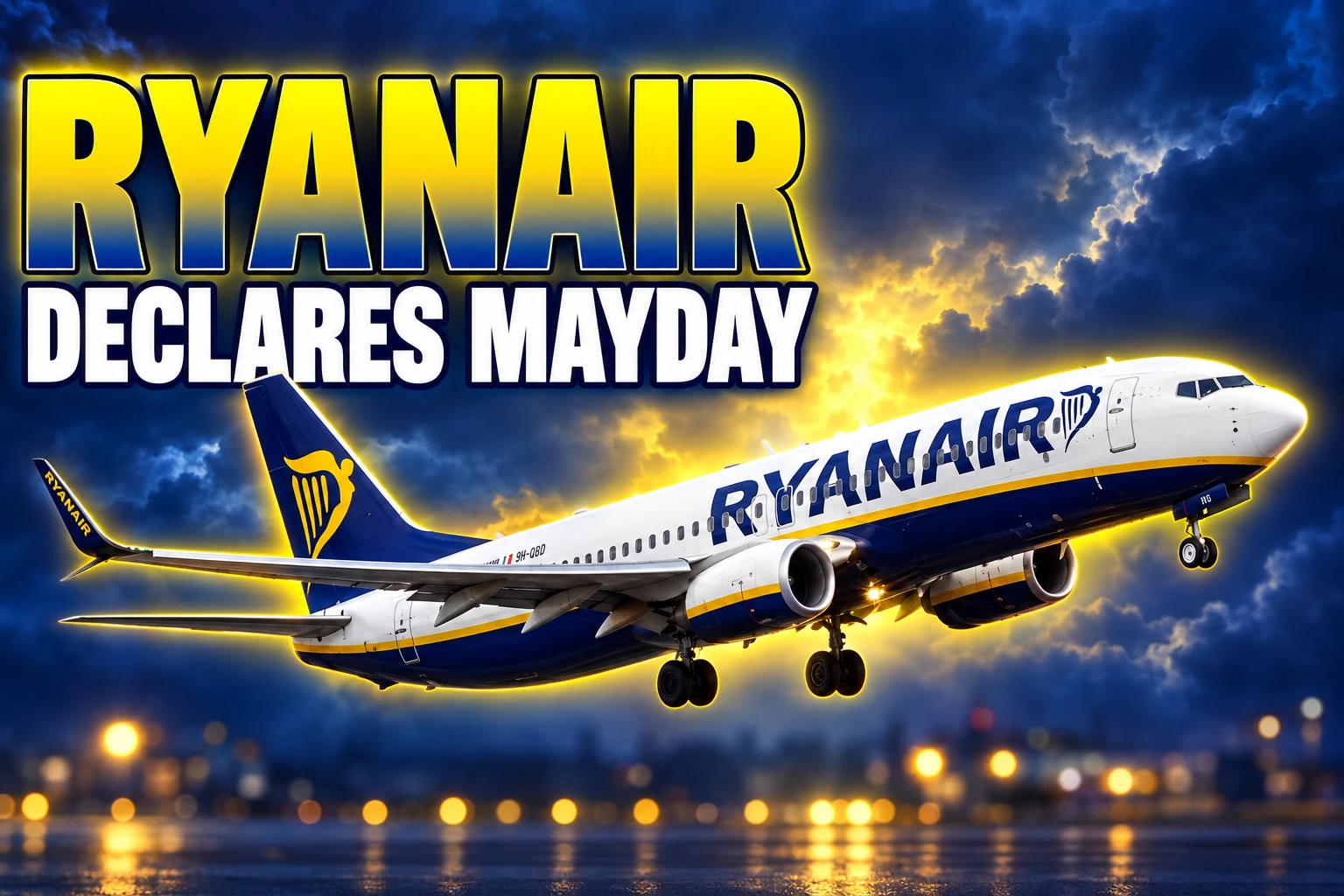
A Ryanair Boeing 737 landed at Manchester with 363 kg of fuel after the airport refused a diversion its own policy said it had to take. Flight FR3418, flown by Malta Air as 9H-QBD from Pisa to Prestwick on 3 October 2025, carried 171 passengers and six crew. The AAIB investigation of Boeing 737-800 9H-QBD, published on 24 September 2026, found the jet had no fuel left for another go-around.
The easy read is a budget airline cutting fuel. The report shows the opposite. The commander had already loaded extra fuel for Storm Amy, then spent it on a detour that Manchester’s own rules said should never have happened.
Manchester Had Already Taken 19 Storm Diversions
After a second windshear escape at Prestwick, the crew told Scottish controllers they would go “straightforward to manchester” if they had to miss again. Company rules barred a third approach after two windshear go-arounds. Manchester was their chosen alternate because the forecast there was kinder than Glasgow, the alternate on the printed plan.
The request reached Manchester at 1829 UTC. Five minutes later Airfield Control told air traffic that the handling agent could not take the aircraft. The pilots heard that refusal at 1837 UTC, with no reason attached. The airport had already accepted 19 Storm Amy diversions that day, and the Excess Parking Plan was not even in force.
THE 15 MINUTES MANCHESTER SAID NO
- 1822 UTC: The crew tells Prestwick that a second missed approach means a diversion to Manchester.
- 1829 UTC: Manchester air traffic receives the request and calls Airfield Control for a decision.
- 1834 UTC: Airfield Control says the handling agent is unable to accept the aircraft.
- 1837 UTC: The refusal reaches the pilots, with no explanation passed on.
Manchester’s written policy puts that call on Airfield Control, not on a ramp contractor. Declared emergencies and medical diversions are always to be accepted. Ordinary diversions are to be accepted when a stand exists. The handler is to be told, not asked.
MANCHESTER’S WRITTEN DIVERSION RULES
- Ground capacity: Diversions are accepted when there is space on the ground, including stands opened under the Excess Parking Plan.
- Emergencies: Declared emergencies and medical diversions are always accepted.
- Who decides: Airfield Control makes the call on flight safety and stand space; the handling agent is notified only.
- What the handler later said: Its own policy was to accept this operator’s diversions. No record of the 1834 UTC exchange was kept, so investigators could not say how the refusal was made.
The 17-page AAIB bulletin on 9H-QBD called it a breakdown of communication between units inside the airport. The handler is not named. After the incident Manchester restated that Airfield Control decides and handlers stay out of the choice. It also restated that an airline still needs a handler on file to use Manchester as an alternate at all.
The Extra Fuel Hit a Runway Weight Cap
Storm Amy was the Met Office’s first named storm of the season, and by 1800 UTC a 952 hPa low sat near Cape Wrath. Ryanair had sent a storm pack with four safety bulletins the day before, then an email on the morning of the flight that told crews to fuel for the furthest alternate and add commander’s extra.
The 33-year-old commander, with 6,272 hours of which 5,889 were on type, and the co-pilot each planned the sector at home from a 57-page pack released at 0724 UTC. At Pisa they compared notes and agreed. Glasgow was the computer’s alternate, at 991 kg. They switched to Manchester, which needed 1,606 kg, another 615 kg, because the weather there was better. The commander then added 1,322 kg, about 1 hour 12 minutes more flying, taking discretionary fuel to 1,937 kg and planned fuel to 11,500 kg. Just before taxi the tanks read 11,671 kg.
They still could not take as much as they wanted. Prestwick’s longer Runway 30 had a forecast crosswind outside the aircraft’s limits, so the landing was expected on shorter Runway 20. That capped landing weight, which capped takeoff weight at Pisa, which capped the extra. The flight left 73 minutes late, at 1528 UTC, against a 1415 UTC slot. Changing the filed alternate to Manchester would have meant a call to operations and a new plan that could take 15 minutes, so Glasgow stayed on the ATC plan. An alternate on a plan does not reserve a stand, and the destination airfield never sees that form.
Three Windshear Warnings, Then Edinburgh
Surface wind at Prestwick on the first approach was 240 degrees at 29 kt, gusting 45 kt. Autopilot and autothrottle came off at about 1,200 ft. Approaching 264 ft above the airfield a two-tone siren and a “windshear, windshear, windshear” callout fired. The commander flew the escape, then a standard go-around, and held at the Turnberry VOR at 6,000 ft.
They waited about 20 minutes to see whether another of the airline’s 737s could get in. That jet landed and reported a 25 kt speed loss at 500 ft. A second approach was allowed only if the commander thought it would work. Around 50 ft another warning fired, with the wind 230 degrees at 34 kt, gusting 46 kt. Prestwick later logged gusts to 56 kt.
Glasgow’s ATIS was reporting windshear on finals, so that nearer option was out. Edinburgh’s weather, passed through Scottish ATC, showed strong wind but no windshear, with some earlier go-arounds. The Manchester refusal sat with them for six minutes before they asked for Edinburgh, and the new clearance took another five. In that gap they talked about calling minimum fuel or a mayday to force Manchester, then agreed their fuel did not yet meet the company’s emergency line. They climbed to FL150 and did not tell the company about the diversion, citing workload, until they were on the ground.
Edinburgh’s ATIS was 240 degrees at 34 kt, gusting 46 kt, for Runway 24. Approach said no landing aircraft had reported windshear. At 745 ft the third warning fired. They escaped again. ATC turned them north for another try. Gusts at Edinburgh had already reached 54 kt that evening.
FUEL LEFT AT EACH STAGE
| Point in the flight | Fuel on board | Against the 1,101 kg reserve |
|---|---|---|
| First go-around, Prestwick | 4,608 kg | Still above diversion fuel to Manchester |
| Second go-around, Prestwick | 3,515 kg | Company then required a diversion |
| Third go-around, Edinburgh | 2,164 kg | About 2,100 kg as they chose Manchester |
| Mayday, leaving Edinburgh | 2,036 kg | 2,800 kg was needed to land with the reserve |
| Touchdown, Manchester 23R | 363 kg | A third of the 1,101 kg final reserve |
| Engines shut down on stand | 240 kg | Low-fuel alerts had already lit both tanks |
The enhanced ground-proximity system stored three shear events. The maker told the AAIB the box worked as designed and that total shear had reached the warning threshold each time. These were not ghost alerts.
Why the Crew Did Not Divert to Newcastle
They had about 2,100 kg left and needed 2,800 kg to reach Manchester with the 1,101 kg final reserve intact. A pad estimate put them overhead with 500 to 700 kg. Once the co-pilot loaded the Manchester approach, the flight computer said 300 kg on landing. Both numbers sat below the reserve. The commander called “mayday mayday mayday fuel” at 1912:34 UTC and asked to go south at once.
Newcastle had been in the briefing pack. When they turned south its wind was 290 degrees at 22 kt, the lightest of the night. The report says they never considered it, and never considered turning back to Edinburgh, once they were on the way. They were set on preparing the Manchester approach and watching the wind. Low-fuel lights came on in the cruise, first the left tank, then the right, after a 100 kg imbalance was evened. They did not run the low-fuel checklist. The commander said the reason for the light was already obvious.
The crew had considered Manchester to be their preferred alternate airport from the outset and it is possible that this influenced their decision-making.
Air Accidents Investigation Branch, bulletin AAIB-31283
The operator later told investigators that doubt about a safe landing at Edinburgh, after the third warning, could have justified an emergency call earlier under the company manual. The crew had gone to Edinburgh on a report of strong wind without windshear, while Glasgow was reporting shear. After the third escape they judged that staying put could trap them into flying through a warning with nowhere else to go. Manchester, they thought, would let them land.
What a Fuel Mayday Requires From a Crew
Ryanair’s approved fuel scheme, like the UK rule then in force, builds taxi, trip, a 5% contingency, diversion fuel and a final reserve. For a jet that reserve is 30 minutes at holding speed at 1,500 ft. On this flight that number was 1,101 kg. The company manual tells captains to protect that figure first, then, if it cannot be protected, to declare a fuel emergency and look at any landing, including ones that break normal methods.
Minimum fuel is a different call. It tells air traffic the crew is committed to one airport and that any further delay could eat the reserve. It is not an emergency. A fuel mayday means the crew expects to land below the reserve. Manchester’s policy is to take every declared emergency. After the second Prestwick miss, the pilots decided they were not yet at that line, so they did not use the call that would have opened Manchester on the first ask.
TWO FUEL CLOCKS ON THE SAME 363 KG
- Holding clock: The 1,101 kg reserve is 30 minutes of holding, so 363 kg is about 10 minutes in that same regime.
- Go-around clock: At go-around power the two CFM56-7B engines burned about 3,600 kg an hour each, 120 kg a minute together, so 363 kg is about 3 minutes of that thrust.
- AAIB finding: Another go-around at Manchester was unlikely to have been possible with enough fuel.
Those are two burns, not two readings. The tanks held 363 kg at touchdown either way. Predicted arrival fuel had briefly risen to 900 to 1,000 kg once the short routing to ROSUN and FL230 went into the computer, then fell again on the climb south.
The Jet Landed Where Manchester Had Said No
Manchester cleared them to a 10 nm final for Runway 23R. The aircraft touched down at 1952 UTC with 363 kg, 4 hours 24 minutes after leaving Pisa and 1 hour 45 minutes after the first Prestwick go-around. On stand, with the engines stopped, the flight-data recorder showed 240 kg. Nobody was hurt. The airframe was undamaged. Gusts at Manchester that evening topped out at 37 kt.
Public argument after the report leaned on the fare. The tanks already held the extra 1,322 kg the storm email had asked for. What emptied them was a 15-minute refusal by a party that was not supposed to decide, a five-minute wait for Edinburgh, a third genuine shear warning, and a crew that had picked Manchester before engine start and kept picking it after the computer said they would arrive below the reserve.
Manchester has told its stakeholders again that Airfield Control accepts diversions when a stand exists, and that handlers do not get a vote. The unnamed agent is still the gap in the record. The next named storm will test whether that 1834 UTC call has actually been taken off the line.
Frequently Asked Questions
How is final reserve fuel calculated for jet airliners?
UK rules in force on 3 October 2025 set final reserve for turbine aeroplanes as fuel to fly 30 minutes at holding speed at 1,500 ft (450 m) in standard conditions, worked out with the estimated mass on arrival at the alternate, or at destination if no alternate is required. Piston-engined aeroplanes use 45 minutes. The figure is a planning floor, not a fuel type of its own, and extra fuel above it stays at the commander’s discretion.
What does a windshear escape manoeuvre require from pilots?
A windshear warning on this 737 required a manually flown escape that uses maximum thrust rather than go-around thrust, leaves the landing gear and flap setting unchanged, and holds a pitch attitude chosen for maximum climb, not for a standard missed approach. Once the jet is clear of the shear, the crew recovers to a normal climb and then flies the published missed-approach path.
At what fuel level does a Boeing 737 show a low-fuel alert?
On 9H-QBD the amber low-fuel-quantity light for each main tank comes on at 1,000 lb, which is 454 kg in that tank. The left tank lit first on the run to Manchester, the crew balanced a 100 kg split, and the right tank then lit as well. Those lights are a tank warning, not the same trigger as a fuel mayday call to air traffic.
Does naming an airport as an alternate on the flight plan reserve a parking stand?
No. The AAIB noted that alternate airfields are not sent a copy of the flight plan, so a diversion still has to be coordinated through air traffic on the day. FR3418’s filed alternate remained Glasgow even after the crew chose Manchester, because swapping it would have meant a phone call and a reissued plan that could take 15 minutes.

Ryanair Fuel Mayday Followed a Diversion Manchester Should Have Taken

Gates Pushes AI Laws He Says Will Not Slow Labs

Carnegie Deli Reopens in the Stage Deli’s Old Shop

Karamtara Wins the QIB Vote as Six IPOs Open

A Quiet German Wiki Caught OpenAI’s Agent Swarm

LSU Players Carry the Cost of Kiffin’s NFL Additions
A Quiet German Wiki Caught OpenAI’s Agent Swarm

Welspun’s Record US Order Is Still a Gas Export Line

Palo Alto Networks Stock Slips as the $20 Billion Bet Tightens
Carnegie Deli Reopens in the Stage Deli’s Old Shop
-
 NEWS4 weeks ago
LSU Players Carry the Cost of Kiffin’s NFL Additions
-
 NEWS3 weeks ago
A Quiet German Wiki Caught OpenAI’s Agent Swarm
-
 BUSINESS4 weeks ago
Welspun’s Record US Order Is Still a Gas Export Line
-
 BUSINESS4 weeks ago
Palo Alto Networks Stock Slips as the $20 Billion Bet Tightens
-
 LIFESTYLE3 weeks ago
Carnegie Deli Reopens in the Stage Deli’s Old Shop
-
 BUSINESS3 weeks ago
Karamtara Wins the QIB Vote as Six IPOs Open
-
 NEWS1 day ago
Gates Pushes AI Laws He Says Will Not Slow Labs