
GAMING
Steam Frame Arrives as a $1,059 Wireless PC Headset
Valve’s Steam Frame is a $1,059 standalone VR kit that still leans on a PC stream, a short battery, and a thin verified game list.

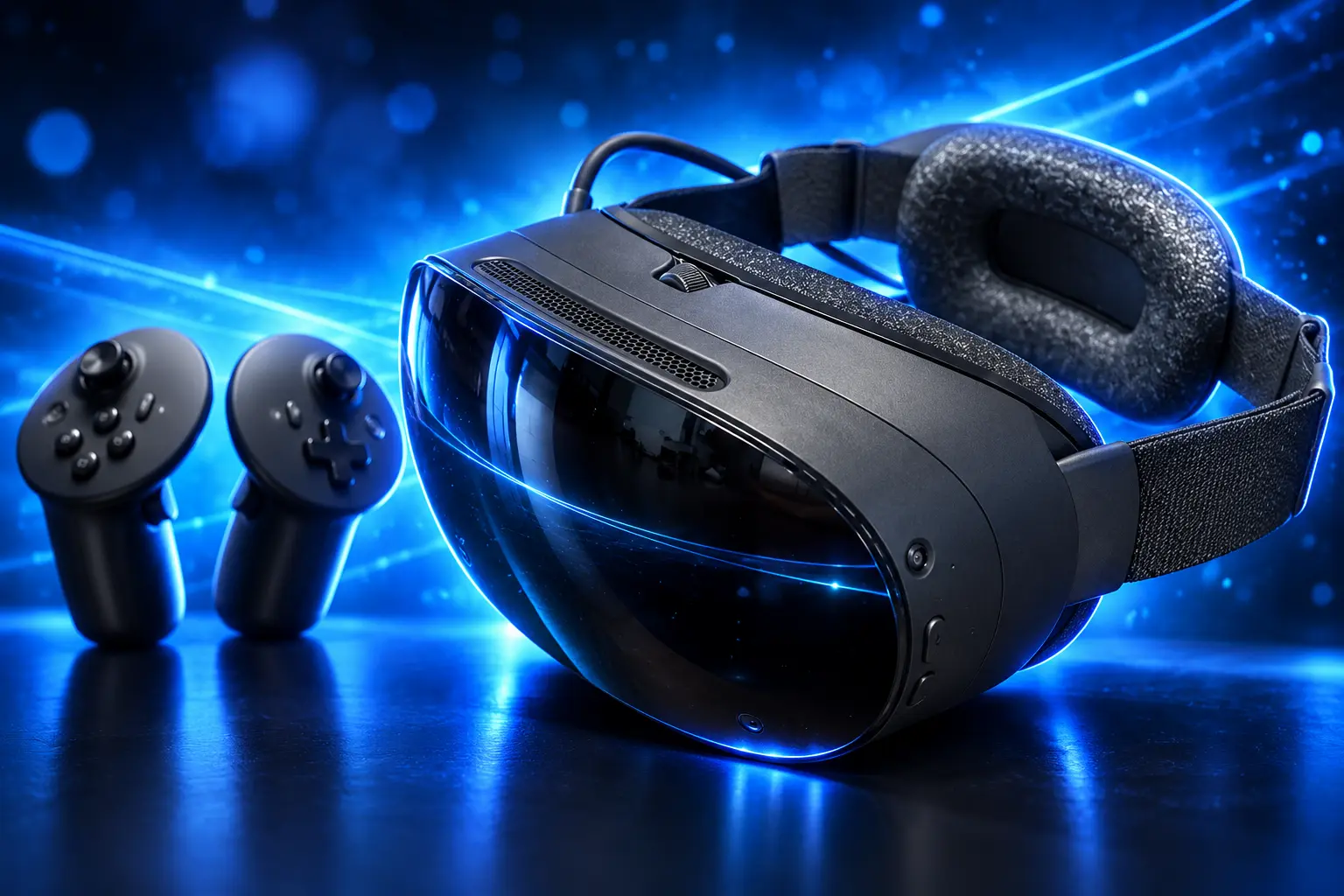
Valve opened a randomized reservation list on September 14 for the Steam Frame, a $1,059 standalone VR headset that still leans on a PC. The visor is light, wireless, and running SteamOS 3 on a Snapdragon 8 Gen 3. The accessory that actually carries Steam’s VR library is a Wi-Fi 6E USB adapter in the same box.
Valve’s store copy calls that arrangement by name. The Frame is a streaming-first headset that can also play games on its own. After a week on a review unit, those two jobs are not equals.
A Standalone Headset That Ships With a Dongle
The product page does not hide the bet. “Steam Frame is a streaming-first, wireless VR headset + controllers that can handle your whole Steam library,” Valve wrote, then added that it “supports stand-alone play too.” Steamworks is blunter with developers: the headset is primarily designed for high quality game streaming from a PC, and it also happens to be a full PC running SteamOS.
Streaming can be highly variable, so we prioritized making Steam Frame a stable, high quality streaming experience.
Valve, Steam Frame product page
That priority shows up as hardware. The visor uses Wi-Fi 7 with two radios, one for the home network and one for the stream. In the box is a plug-and-play 6 GHz adapter that builds a dedicated link to a nearby Windows PC. Valve’s new Foveated Streaming trick, driven by the headset’s eye cameras, is sold as a way to spend bandwidth only where you look, with a claimed jump of over 10x in image quality and effective throughput.
On a review unit the wireless hop sat at five to ten milliseconds of ping, which is low enough to stay in the game. Setup was the weak point, with streams that sometimes needed a restart or a poke at the SteamVR app on the desktop. Once it locked, the Frame stopped pretending to be a phone on your face and became what the dongle always said it was: a wireless monitor for a real graphics card.
Reservations Close on September 17
Valve is not putting the kit in a normal cart. Sign-ups opened September 14. Eligible buyers may join for one model only. The list shuts Thursday, September 17, 2026 at 1:00 p.m. EDT, then Valve randomizes it and emails results within a day.
THE RESERVATION CLOCK
- November 2025: Valve reveals the Steam Frame with the Steam Machine and a new controller, still without a price.
- September 14, 2026: The store lists the 256GB kit at $1,059 and the 1TB kit at $1,299, and the reservation form goes live.
- September 17, 2026, 1:00 p.m. EDT: The list closes and is shuffled.
- Within a day of the cutoff: Valve emails people who landed a slot, and everyone else waits.
The 256GB kit for $1,059 is the one most people will stare at. Both kits include the visor, Steam Frame Controllers with full 6-DoF tracking plus gamepad controls, the Wi-Fi 6E adapter, and a copy of Half-Life: Alyx. Both skip a charger. Valve will sell a 45W Steam Hardware Power Supply for $29, and any 45W or higher USB-C brick will do, including a Steam Deck charger.
SOLD NEXT TO THE HEADSET
- Power supply: $29 for a 45W USB-C brick with a 2.5 m cable, because the $1,059 kit has no dedicated PSU.
- Ergonomic kit: $59 for controller hand straps, a top strap, and an extended light blocker.
- Replacement kit: $49 for a face gasket, head cushion, and the standard light blocker.
Color passthrough is not in the visor. Valve points buyers to an Arcturus Vision camera that plugs into a front expansion port. Prescription inserts come from Zenni. The extra spend sits on top of a price that already clears four digits before tax.
A Phone Chip Tries to Run SteamVR
Take the dongle out of the story and the Frame is a 440 g visor with a 185 g core, a rear 21.6 Wh battery, and Qualcomm’s Snapdragon 8 Gen 3 with 16GB of LPDDR5X. Pancake lenses sit in front of 2160 x 2160 LCD panels per eye. Refresh runs from 72 Hz to 144 Hz, and Valve still marks 144 Hz as experimental. Inside-out cameras handle tracking. There is a microSD slot, the same cards the Steam Deck and Steam Machine use.
The comfort is the part reviewers keep coming back to. Roughly half the mass lives in a cushioned battery behind the skull, so the front does not drag the way a 515 g Quest 3 can. Long sessions held without a break. The ski-goggle face cushion still traps heat, the rear bump fights a headrest in seated play, and thin glasses get pinched even with the magnetic spacer. Those are annoyances on a headset you can actually wear.
Unplugged play is the bill. In SteamOS Performance mode, most VR titles barely crawled past an hour and a half on a full charge, with a constant fan blowing hot air off the forehead and a whine you can hear. Playtime mode stretched sessions well above two hours by cutting rendering and locking a 72 Hz refresh, which brought blur in the distance, stair-step edges, and jitter when you turned your head. The longer mode is hard to recommend if you have a PC in the next room.
Standalone software is the other tax. SteamOS on ARM is new in a way the Deck’s AMD chip was not. Doom VFR and I Expect You To Die 3 refused to launch on a review unit. Fruit Ninja and Valve’s own The Lab threw hard graphical glitches. Six titles crashed the whole device and needed a restart. Returnal, which can hold a Playable 30 fps on a Steam Deck, managed 9 fps at 720p Low on the Frame. Assassin’s Creed Mirage would not load at all.
Valve’s answer for that mess is a stack of translation tools. Windows games go through Proton. x86 code is translated to Arm64 by FEX. Android builds sit in Lepton, a container Valve prefers when a studio already shipped a mobile VR build. The Proton, FEX, and Lepton layers are how Valve wants one “best” build to reach the visor without a separate Frame SKU. On day one, that is still a hope more than a catalog.
Alyx Renders at 36 fps on the Headset
Every Frame includes Half-Life: Alyx, Valve’s 2020 VR flagship, rebuilt to run on the Snapdragon instead of a desktop GPU. Project lead Robin Walker and engineer Autumn Ashton have been clear that the team did not believe that would work. Alyx was built with no real performance compromises. The thing that changed the argument was the Frame’s eye tracking, foveated rendering, and 16GB of memory, which let Valve leave the game’s assets alone so Workshop maps still load.
The native build does not run at the headset’s pretty 144 Hz number. Ashton said the game is rendering at 36 fps and using depth reprojection to keep motion smooth, including the hard case of a hand held up against a different background. She also said the port would not have been shippable without gaze data feeding foveated rendering. Walker described the year after the first prototype as unglamorous driver and SteamVR work.
It’s not particularly sexy, I guess, but then there’s just a year and a half of grinding software work as we work through drivers, new features in SteamVR and so on.
Robin Walker, project lead, on the Alyx Frame port
Ashton called Alyx a forcing function for the rest of the stack, including third-party titles that still need motion vectors and depth for the compositor. You can still stream the Windows copy from a PC if you want a sharper image and a longer battery. The native version is the proof that the visor can hold a heavy VR game without that PC. It is also the proof of how hard that is, and how old the showpiece is.
The Verified List Is Still a Short Shelf
Valve’s customer-facing filter is Great on Frame, the Deck Verified idea pointed at this headset. Steam’s own page listed 132 Great on Frame titles when reservations opened. That number mixes VR games and flat Steam games you play on a virtual screen inside the visor. Beat Saber, Pistol Whip, Superhot VR, Walkabout Mini Golf, Portal 2, Balatro, and Hollow Knight: Silksong are the names people will look for. Alyx is bundled with the hardware and is not sitting on that certified list.
The bar behind the badge is written for developers, and it is not the 144 Hz panel talking. To earn Verified, a VR title must hold 72 fps at 1728×1728 in normal play. Flat games need 30 fps at 1280×720. A VR title that renders below 1440×1440 is marked Unsupported. Controller models have to show the Frame pads, glyphs have to match, and launchers have to be usable without a keyboard. The review does not apply to games you stream from a PC, which is another way of saying the full Steam library still lives on the other side of the dongle.
WHAT VERIFIED ACTUALLY DEMANDS
- VR floor: 72 fps at 1728×1728, or the badge does not land.
- Hard fail: VR rendering below 1440×1440 is Unsupported.
- Flat floor: 30 fps at 1280×720 for non-VR games on the virtual screen.
- Input: default Frame controller config must reach every function, with matching glyphs.
A few dozen of those 132 entries are the VR games a buyer actually wants to launch without a tower. The rest are lighter 2D and older 3D titles that fit a phone chip. I Expect You To Die 3 has appeared on certified lists and still failed to load on a review unit, which is the Deck-era lesson all over again: the badge can move faster than the build.
Meta Sells the Quest 3 for $599.99
The comparison everyone reaches for is Meta’s Quest 3, and the math is ugly if you treat the Frame as a same-job standalone. On April 16, 2026, Meta said memory costs were forcing a rise, and from April 19 the Quest 3 512 GB at $599.99 became the US list, with the Quest 3S at $349.99 for 128GB and $449.99 for 256GB.
WHAT $1,059 BUYS AGAINST THE QUEST 3
| Headset | US list | Storage | On-device chip | Weight |
|---|---|---|---|---|
| Steam Frame 256GB | $1,059 | 256GB UFS plus microSD | Snapdragon 8 Gen 3, 16GB | 440 g |
| Steam Frame 1TB | $1,299 | 1TB UFS plus microSD | Snapdragon 8 Gen 3, 16GB | 440 g |
| Meta Quest 3 | $599.99 | 512GB | Snapdragon XR2 Gen 2 | 515 g |
The Frame is lighter, has more memory, ships a dedicated 6 GHz adapter, and keeps you off a Meta account. The Quest 3 has had years of software iteration, a color passthrough camera in the visor, and a store full of mobile VR that already targets that Snapdragon class. A solid home Wi-Fi network can already stream SteamVR to a Quest 3. You pay hundreds more on the Frame for comfort, the dongle, Linux on the face, and Alyx in the box.
The four-digit tag is doing more damage than any one spec. People who followed the November 2025 reveal had been primed for a kit that would feel like Valve hardware priced like Valve hardware. $1,059 reads as a PC accessory with a visor attached. The battery argument online is sloppier: a two-hour Playtime session is normal in this class, including on the Quest 3. The Frame’s problem is the other mode, the one that looks good, dying closer to 90 minutes.
Who Should Join the Queue?
Buyers who already own a fat SteamVR library, and a PC that can feed it, are the ones the dongle was designed for. The visor is the nicest wireless client that stack has had, and the dual-radio link is the feature that review time actually praised. Tinkerers who want a Linux desktop without Meta’s developer hoop, and anyone who will not sign into a Meta account, have a real reason that does not show up on a Quest spec sheet.
If the pitch is “I want a simple standalone headset and I do not already live in SteamVR,” the Frame is a long walk for a thin list. You are paying $1,059, plus a charger if you do not have a 45W brick, for a phone chip that still trips over games Valve has already certified, and for a native Alyx that holds 36 fps with a lot of compositor help. The better picture is still the one coming off a desktop GPU through that USB stick.
The list is open through September 17 at 1:00 p.m. EDT. After that it is a shuffle, not a checkout button.

Trump Claims Eight Wars as Oslo Weighs the Peace Prize

Valkyries and Dream Leave Two Contenders at 0-2

Caroline Pham Teased Ripple as MoonPay Sold ether.fi

The $399 Kickr Core 2 Deal Is a Winter Hook

India Plans to Bar Cane Juice From Ethanol Production

A Quiet German Wiki Caught OpenAI’s Agent Swarm

LSU Players Carry the Cost of Kiffin’s NFL Additions

Carnegie Deli Reopens in the Stage Deli’s Old Shop

Welspun’s Record US Order Is Still a Gas Export Line

Treasury’s $6 Billion Buyback Leaves the 10-Year Higher
-
 NEWS2 months ago
A Quiet German Wiki Caught OpenAI’s Agent Swarm
-
 NEWS3 months ago
LSU Players Carry the Cost of Kiffin’s NFL Additions
-
 LIFESTYLE2 months ago
Carnegie Deli Reopens in the Stage Deli’s Old Shop
-
 BUSINESS3 months ago
Welspun’s Record US Order Is Still a Gas Export Line
-
 BUSINESS2 months ago
Treasury’s $6 Billion Buyback Leaves the 10-Year Higher
-

 BUSINESS2 months ago
Palo Alto Networks Stock Slips as the $20 Billion Bet Tightens
-
 NEWS2 months ago
vivo X500 Pro Max Keeps Last Spring’s Camera Island
-

 NEWS2 months ago
The Narcolepsy Pill That Opens a Wider Brain Bet