
BUSINESS
Hormel Bets $1.055 Billion on a Chicken Processor
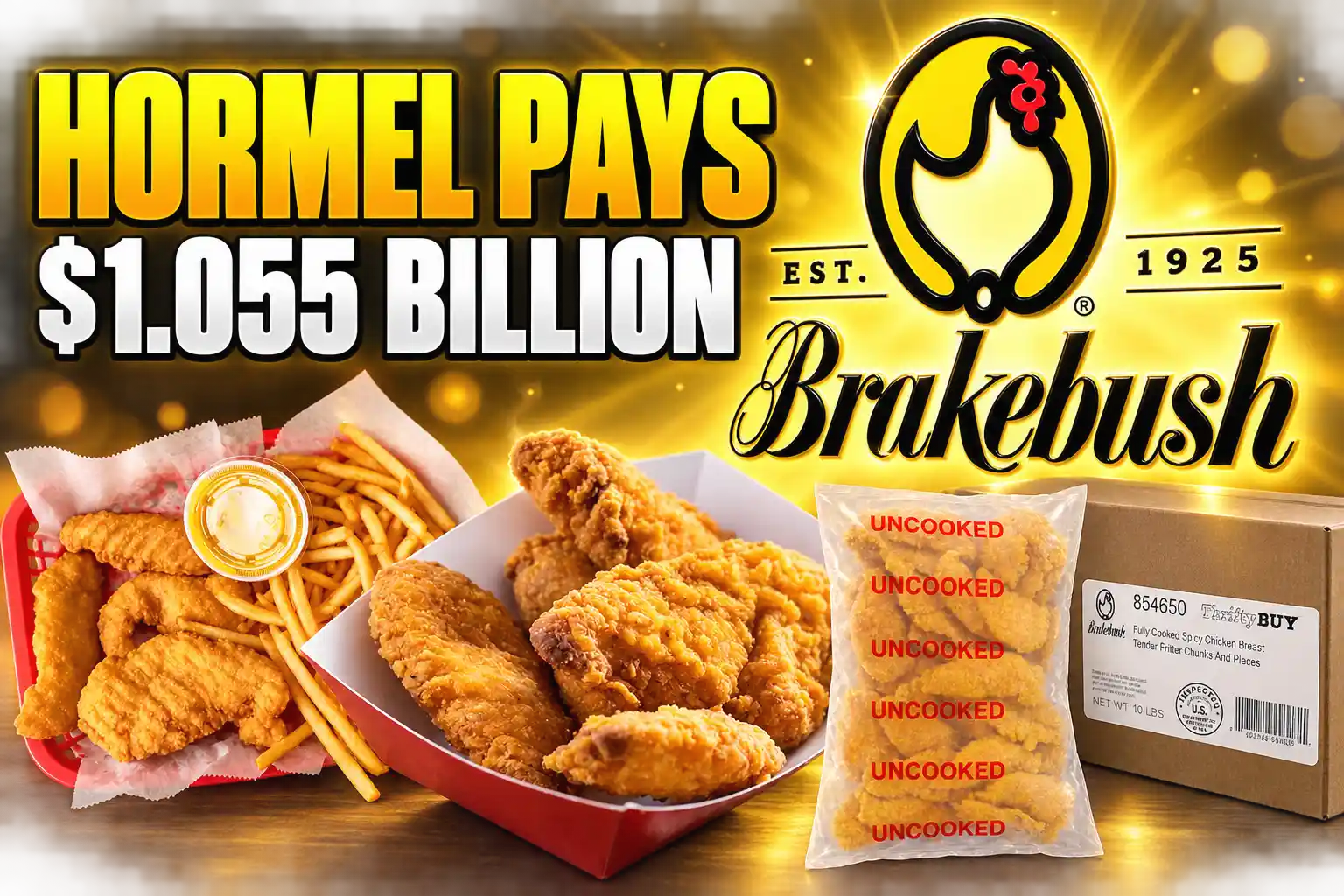
Incoming Hormel CEO John Ghingo is paying $1.055 billion for Brakebush, a foodservice chicken processor, and rating agencies cut the company the same day.

Hormel Foods agreed on September 30 to buy Brakebush Brothers for $1.055 billion in cash from the family that has owned the Wisconsin chicken company since 1925. The Austin, Minnesota, group said the purchase will sit mostly inside its Foodservice segment and will not lift adjusted earnings per share until fiscal 2028.
Incoming chief executive John Ghingo takes over on Oct. 26, 26 days after the announcement and before the deal is due to close. S&P Global Ratings and Moody’s Ratings cut Hormel the same day the company signed the check.
Hormel Agrees to Pay $1.055 Billion in Cash
Hormel and Brakebush Holdings signed a membership interest purchase agreement on September 29. The company published an agreement to acquire Brakebush the next morning, with a base price of $1.055 billion in cash, subject to ordinary closing adjustments. Close is slated for the first quarter of Hormel’s 2027 fiscal year, after Hart-Scott-Rodino waiting periods and other antitrust clearances. The contract can be terminated if the deal is still open on March 29, 2027, with an automatic three-month extension if regulators are still working.
Brakebush had about $1.2 billion of net sales over the last 12 months, so the cash price is about 0.88 times trailing sales. Hormel’s investor slides put the multiple at 10.7 times adjusted EBITDA on a 2026 estimate, or 8.9 times after planned cost cuts. Those cuts are pegged at about $20 million a year by the end of fiscal 2028. Hormel said it will pay with cash on hand and new long-term debt, and that it wants to keep an investment-grade rating.
THE BRAKEBUSH CHECK
| Item | Figure |
|---|---|
| Cash price | $1.055 billion |
| Brakebush trailing sales | about $1.2 billion |
| Sales multiple | about 0.88 times |
| Adjusted EBITDA multiple | 10.7 times (8.9 times after synergies) |
| Run-rate cost synergies | about $20 million by end of fiscal 2028 |
| Foodservice share of Brakebush sales | about 90 percent |
| Target close | Hormel fiscal first quarter 2027 |
Wells Fargo advised Hormel. William Blair advised Brakebush. Interim chief executive Jeff Ettinger called Brakebush a respected leader in value-added chicken and said its team, culture and skills make a fit with Hormel’s foodservice business, which he described as a source of growth.
WHAT WE KNOW
- The price: A base $1.055 billion in cash, subject to ordinary adjustments, for all membership interests of Brakebush Brothers, LLC.
- The clock: Close is aimed at Hormel’s 2027 fiscal first quarter, with a March 29, 2027 drop-dead date and a three-month regulatory extension.
- The reporting line: Brakebush results are slated to land mainly in the Foodservice segment, with adjusted earnings help starting in fiscal 2028.
WHAT IS UNCONFIRMED
- The debt split: Hormel has not said how much of the $1.055 billion will come from cash versus new bonds or loans.
- Who stays: The company has not said whether Brakebush president and chief executive Gregory Huff, or the Brakebush family officers, will remain after close.
- The review: No public timetable has been given for Hart-Scott-Rodino clearance beyond the contract’s outside date.
Barclays analyst Benjamin Theuer called the purchase attractive on strategy and said the market would still argue over the multiple, a near-term rise in leverage, and whether the cost cuts arrive.
Americans Eat More Than Seven Times as Much Chicken as Turkey
Ghingo’s wager sits on a long shift in what people eat. USDA figures compiled for 2025 and 2026 put chicken, measured as broiler meat, at the top of the animal-protein list. Per-person supply is projected at 102.7 pounds in 2025 and 102.8 pounds of chicken in 2026, against 13.0 pounds of turkey in 2025 and 13.6 pounds in 2026. That 2026 gap is more than seven times as much chicken as turkey.
PER PERSON, POUNDS OF MEAT
| Protein | 2025 | 2026 forecast |
|---|---|---|
| Chicken (broiler) | 102.7 | 102.8 |
| Beef | 58.5 | 56.9 |
| Pork | 49.7 | 50.9 |
| Turkey | 13.0 | 13.6 |
Those USDA numbers are disappearance, a stand-in for food that moves through grocery stores and restaurants. From 2015 to 2025, broiler production rose 19.9 percent while turkey production fell 13.9 percent, according to the department’s poultry sector summary. Chicken is the protein Hormel was light on. After the deal, the company’s own pro forma mix for the twelve months ended July 26 still shows pork at about 40 percent of sales by input, with chicken, turkey and beef each around 13 percent and non-meat around 20 percent.
The cash market does not look like a boom. RaboResearch, in a late-September poultry note, put boneless, skinless breast near $1.21 a pound, down 29 percent from a year earlier and close to five-year lows. That is the risk inside the bet. Brakebush does not live on that spot price. It sells cooked, par-fried and portioned chicken on foodservice contracts, a model S&P described as cost-plus with a fixed price, which is a different business from selling commodity breast into retail coolers.
Why Hormel Sold the Whole Bird First
The chicken check follows a year of taking money off the table in slower lines. In February, Hormel moved to whole-bird turkey business assets, including a Melrose, Minnesota, plant and a Swanville feed mill, to Willmar-based Life-Science Innovations. That sale closed on April 24. Hormel kept the Jennie-O brand and its ground turkey, deli, burger and related lines, plus the right to sell Jennie-O Oven Ready whole birds and breasts. Terms were not disclosed. Ettinger said at the time that the company wanted more of its protein in value-added form and less of it in volatile commodity birds.
The timing is awkward on one official number. USDA’s poultry production-and-value report put turkey output at $5.58 billion in 2025, up 51 percent from $3.69 billion in 2024, even as bird counts kept falling. Hormel was not selling the whole Jennie-O franchise. It was selling the Thanksgiving carcass line and keeping the parts that already look like the Brakebush model: cooked, branded, portioned protein.
THE YEAR HORMEL STOPPED SELLING AND STARTED BUYING
- October 2025: Reaches an agreement with Forward Consumer Partners to separate the Justin’s nut butter and chocolate snacks business.
- February 17, 2026: Agrees to sell the whole-bird turkey operation to Life-Science Innovations and keeps Jennie-O value-added turkey.
- April 24, 2026: Completes the turkey sale. The Melrose plant moves to LSI under the Legacy Turkey name.
- June 2026: Agrees to sell the Brazilian Ceratti business to Zanchetta Alimentos.
- July 28, 2026: Names Ghingo chief executive, effective Oct. 26, with Ettinger remaining interim chief through Oct. 25.
- August 2026: Cuts full-year sales guidance after a third quarter of $2.96 billion in net sales and a 2 percent organic decline.
- September 29, 2026: Signs the Brakebush purchase agreement for $1.055 billion in cash.
Third-quarter foodservice was the part of Hormel that still grew. Organic net sales in that segment rose for a 12th straight quarter. Full-year net sales are now guided to $12.1 billion to $12.2 billion, with organic growth of 1 percent to 2 percent, down from an earlier 1 percent to 4 percent band. Adjusted operating income is guided to $1.08 billion to $1.12 billion, and adjusted earnings per share to $1.45 to $1.51. Diluted earnings per share were cut to $1.06 to $1.12. Cash on hand was $840 million on July 26. On a pro forma basis after Brakebush, Hormel’s slides put Foodservice at 40 percent of sales, Retail at 55 percent and International at 5 percent.
Brakebush Sells Almost Everything Into Foodservice
About 90 percent of Brakebush’s fiscal 2025 commercial net sales went to foodservice. About 10 percent went to retail. That mix is why this is not a grocery-brand story in the mold of Applegate or Hormel Natural Choice, the chicken lines Hormel already sells in stores. It is a bet on operators, a direct sales force, and cooked product that shows up on a restaurant ticket.
The company is a non-vertically integrated processor, meaning it buys chicken rather than raising the birds. It runs five plants and two research labs and sells fully cooked, par-fried and raw portioned items. Hormel said the added sales team, category skill and operator ties should widen its foodservice reach with national and regional accounts. After close, chicken still would be only about 13 percent of Hormel’s pro forma sales by input, level with turkey and beef. The $1.055 billion does not turn Hormel into a chicken company. It fills a hole.
THE FIVE PLANTS IN THE DEAL
- Westfield, Wisconsin: Headquarters and the original site, a fully cook plant of more than 553,000 square feet with six lines, capacity above 2.3 million pounds a week, and more than 1,100 people.
- Wells, Minnesota: A further-processing site added in 2016, putting cooked chicken inside Hormel’s home state.
- Mocksville, North Carolina: A House of Raeford plant bought in 2018 after a fire and rebuilt in 2019 as a value-added and fully cooked site.
- Irving, Texas: A raw portioning plant acquired in 2013, using water-jet cutters for sized product.
- Hartwell, Georgia: A Lake Foods plant acquired at the end of 2023, the fifth site in the network.
Brakebush also runs its own refrigerated fleet, listed at more than 90 trucks and 230 trailers, a leftover of a business that began as haulage. Fourth-generation family members still work in the company alongside more than 2,500 people.
A Century of Family Ownership Ends in Westfield
William and Otto Brakebush one truck in 1925 and used it to move livestock and poultry from Westfield to Madison and Milwaukee. They added eggs, then dressing and freezing, then a plant in 1941. Precooked chicken and breading became the core in the 1960s. Tenders, fillets and nuggets followed in the 1970s. Carey Brakebush, chairman of the board, is the family name on the sale.
Brakebush has always been a people-first company, built on strong relationships, shared values and a commitment to doing business the right way. We see those same qualities in Hormel Foods. Their culture, integrity and long-term approach to growth give us great confidence that Brakebush will continue to thrive for our employees, customers and communities in the years ahead.
Carey Brakebush, Chairman of the Board, Brakebush, in Hormel’s September 30 statement
Gregory Huff, who joined as chief financial officer in 2015 and became president and chief executive in 2022, is the non-family operator who added the Georgia plant. Family officers listed on the company’s site include Carey as vice president of facilities, Chris as vice president of purchasing and planning, and Jon as senior vice president of operations. For a closely held firm that marked 100 years in 2025, $1.055 billion is the exit. For Hormel, it is a rare shot at a scaled cooked-chicken platform that was not already inside a larger meat group.
The Multiple That Cost Hormel a Notch on Its Rating
The 10.7 times multiple is the part of the wager Wall Street will keep scoring. On a sales basis the price is about 0.88 times, which is not exotic for a cooked, contracted processor. On earnings it is full, and the help to adjusted earnings per share does not start until fiscal 2028, so buyers of Hormel stock are funding a deal that sits on the books before it sits in the profit line.
Hormel’s own slides show net debt to adjusted EBITDA at 1.5 times for the twelve months through the third quarter, inside a 1.5 times to 2.0 times target, and “low-2x” after the purchase. S&P used a different adjusted-leverage gauge and put the company at 1.8 times before the deal and 2.5 times at close, above the target for more than two years. It cut the issuer credit rating to BBB+ from A minus. Moody’s cut senior unsecured debt to A3 from A2 and cited a pro forma debt-to-EBITDA figure of 2.8 times, a third gauge. Both firms assigned a stable outlook and said cash should go to debt paydown rather than the next purchase.
WHAT THE BET COSTS ON PAPER
- Hormel’s yardstick: Net debt to adjusted EBITDA at 1.5 times through July 26, with a post-deal print described as low-2x against a 1.5 times to 2.0 times target.
- S&P’s yardstick: Adjusted leverage from 1.8 times to 2.5 times at close, and a cut to BBB+ from A minus.
- Moody’s yardstick: Debt-to-EBITDA of 2.8 times pro forma, and a cut to A3 from A2.
- The wait: About $20 million of cost synergies by the end of fiscal 2028, which is also when adjusted earnings per share are first expected to rise because of the deal.
That is a fair bill for a company that still wants to be treated as a dividend aristocrat with an investment-grade name. The flip from a year of disposals to a billion-dollar buy is the other half of the argument. People who watch food deals treated 10.7 times as rich against recent protein trades and treated the sales multiple as more ordinary. Both can be true at once when EBITDA is thin relative to a $1.2 billion top line.
Ghingo Takes Over Before the Deal Closes
Ghingo, 53, becomes president and chief executive on Oct. 26. Ettinger, who came back as interim chief after Jim Snee retired, stays in the job through Oct. 25 and remains a director. Ghingo has been president and a director since July 2025. He rejoined Hormel in 2024 to run Retail after a first tour as president of Applegate Farms from 2018 to 2022, a stretch at WhiteWave on Silk and So Delicious, and more than 15 years at Mondelēz International on brands including Oreo, Cadbury and Trident. He graduated from Notre Dame and holds an MBA from NYU Stern.
Chicken has been one of the most attractive growth categories in protein, and Brakebush has built an exceptional platform to serve that demand. Hormel Foods has built a strong Foodservice business by helping operators succeed through innovation, service and value-added solutions. We believe that Brakebush will bolster our capabilities, bringing additional scale, expertise and customer reach, in support of our long-term growth strategy.
John Ghingo, President and Chief Executive Officer-elect, Hormel Foods, September 30 statement
The sequence is the wager. Ghingo inherits a company that has already sold whole birds, a Brazil unit and a snack brand, cut its sales outlook, and now owes the agencies a lower rating because it spent $1.055 billion on cooked chicken it will not fully own until fiscal 2027. If operators keep buying tenders, fillets and nuggets, the Foodservice line that has grown for 12 quarters gets a second engine. If the multiple is too high, or the $20 million of cuts slip, the first large decision of his term sits on the balance sheet long before it shows up in adjusted earnings.
He takes the keys on Oct. 26. The Brakebush family takes the $1.055 billion when regulators are done. Adjusted earnings are not scheduled to feel it until fiscal 2028.
Disclaimer: This article is news reporting and analysis of a pending corporate purchase and related credit ratings. It is for information only and is not investment advice, a recommendation to buy or sell Hormel Foods stock or any other security, or advice on how to interpret S&P or Moody’s rating actions. Readers who may act on deal terms, leverage figures or earnings guidance should consult a licensed financial adviser or other qualified investment professional who can review their own holdings and risk. Prices, ratings, close timing and company guidance are those given by the cited filings and statements as of the dates in this piece and can change with regulators, markets and later company updates.

Alison Hammond Left This Morning and Apologised From Hospital

Thai Airways Lost Its CEO as Golden Week Guests Still Arrived

Roosevelt Steams East as Trump Times Iran to November

Hormel Bets $1.055 Billion on a Chicken Processor

Spiral Brain Waves Carry Memory Beyond Fixed Wiring

A Quiet German Wiki Caught OpenAI’s Agent Swarm

LSU Players Carry the Cost of Kiffin’s NFL Additions

Welspun’s Record US Order Is Still a Gas Export Line

Palo Alto Networks Stock Slips as the $20 Billion Bet Tightens

Carnegie Deli Reopens in the Stage Deli’s Old Shop
-
 NEWS4 weeks ago
A Quiet German Wiki Caught OpenAI’s Agent Swarm
-
 NEWS1 month ago
LSU Players Carry the Cost of Kiffin’s NFL Additions
-
 BUSINESS1 month ago
Welspun’s Record US Order Is Still a Gas Export Line
-
 BUSINESS1 month ago
Palo Alto Networks Stock Slips as the $20 Billion Bet Tightens
-
 LIFESTYLE4 weeks ago
Carnegie Deli Reopens in the Stage Deli’s Old Shop
-

 BUSINESS3 weeks ago
Trump Times the Iran War to the Midterm Calendar
-
 NEWS3 weeks ago
The Narcolepsy Pill That Opens a Wider Brain Bet
-

 GAMING4 weeks ago
The Zelda Switch 2 Costs Extra and Includes No Game